Hip Gel Injections: Complete Guide to Off-Label Viscosupplementation for Hip OA
Hip viscosupplementation guide: off-label HA injections for hip OA, imaging guidance requirements, Durolane hip data, Medicare coverage, and what to expect from the procedure.
By Joint Pain Authority Team
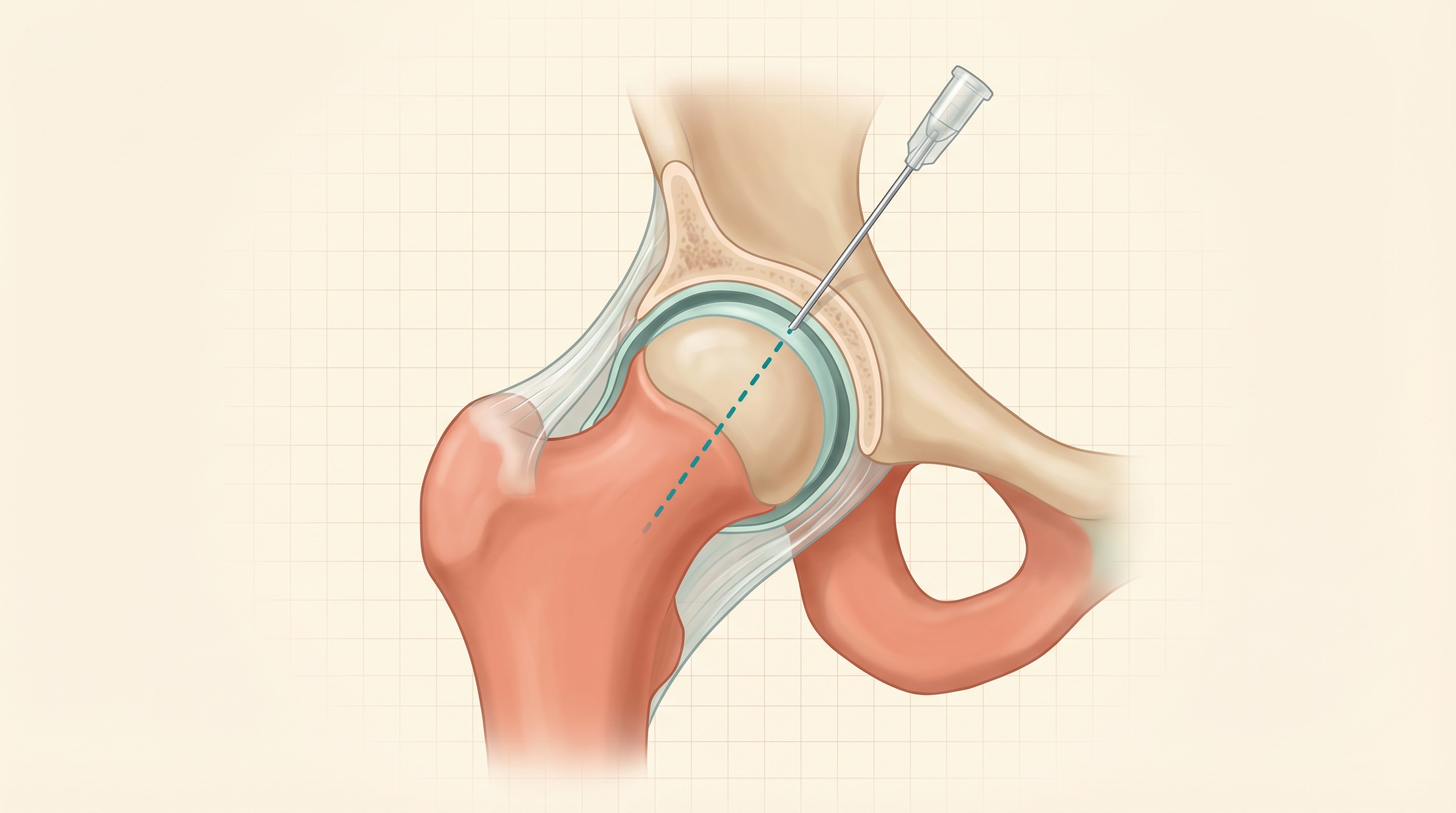
The Short Answer on Hip Gel Injections
Hyaluronic acid (HA) gel injections for the hip are off-label in the United States — FDA approval covers the knee only. Despite this, hip viscosupplementation is widely performed by orthopedic surgeons and pain management physicians, and insurance coverage is often available under the same criteria used for knee injections.
If you’re managing hip osteoarthritis and want to understand your options before considering surgery, this guide covers everything you need to know.
Why HA Injections Are Approved for the Knee but Not the Hip
The FDA approval of hyaluronic acid products (Synvisc, Euflexxa, Durolane, and others) is based on clinical trials conducted primarily in knee OA patients. Hip joint anatomy is more complex — a deep ball-and-socket joint compared to the more accessible knee — making injection accuracy more difficult without imaging guidance.
The clinical trial burden for a separate hip OA indication has not been pursued by most manufacturers. However:
- Off-label prescribing is legal and common. Physicians can prescribe any FDA-approved drug for any use they deem appropriate.
- Durolane has published hip OA data, making it the best-supported HA brand for hip use.
- European markets have broader approval frameworks for hip HA, and the international data are increasingly referenced in US practice.
What Makes Hip Injections Different from Knee Injections
Imaging Guidance Is Essential
Unlike the knee, the hip joint sits beneath layers of muscle, fat, and connective tissue. Blind injection (without imaging) risks missing the joint space entirely, injecting into surrounding bursa or soft tissue.
Standard of care for hip injections:
- Fluoroscopy (X-ray guidance) — Most common; provides real-time visualization. Contrast dye confirms correct joint placement before HA is delivered.
- Ultrasound guidance — Faster, no radiation, increasingly used by experienced practitioners. Real-time imaging confirms needle position.
If a physician recommends a hip HA injection without any imaging guidance, consider seeking a second opinion.
The Hip Joint Is Smaller and Less Forgiving
The hip joint space accommodates smaller injection volumes than the knee. Standard knee formulations may require dosing adjustments for hip applications.
Durolane: The Best-Supported Brand for Hip OA
Durolane (Bioventus) has the most robust published data for hip viscosupplementation:
- DUROLANE Hip OA Study (Waddell et al., 2012) — Single-injection Durolane vs. saline in hip OA. Durolane showed superior pain reduction at 12 weeks.
- AISLING study — European multicenter trial showing Durolane safe and effective for hip OA with single-injection protocol.
Durolane’s single-injection, high-density NASHA formulation is particularly well-suited for hip use:
- One visit (reduces repeat needle access to a deep joint)
- Non-avian (safe for bird/egg allergies)
- 6mL volume appropriate for hip joint capacity
Other brands are used clinically for hip OA, but Durolane’s published hip-specific data makes it the physician’s first choice in many practices.
What to Expect: The Hip Injection Procedure
Before the Procedure
- Your physician reviews your X-rays to confirm OA diagnosis and joint space remaining
- You’re positioned (usually supine/on your back) with the hip accessible
- The skin is cleaned and local anesthetic applied
- Imaging equipment is set up (fluoroscopy or ultrasound)
During the Injection
- The needle is guided into the hip joint space under real-time imaging
- Contrast dye is injected first to confirm correct placement (fluoroscopy) or joint distension confirms position (ultrasound)
- HA solution is slowly injected into the joint space
- The needle is withdrawn and the injection site dressed
Time: Typically 15–30 minutes including setup.
Discomfort: Most patients report mild pressure during injection. Local anesthetic significantly reduces pain. Fluoroscopy uses radiation — if you’re concerned, ask about ultrasound-guided alternatives.
After the Procedure
- Rest for 24–48 hours; avoid strenuous activity
- Ice the hip area if there is soreness
- Avoid swimming, hot tubs, or submerging the injection site for 24 hours
- Most patients can drive home, though having a driver is recommended
Expected Benefits and Timeline
| Timeframe | What to Expect |
|---|---|
| Days 1–3 | Possible soreness at injection site; normal |
| Week 1–2 | No significant benefit yet — HA is integrating |
| Week 3–6 | Gradual improvement in hip pain and mobility |
| Months 2–6 | Peak benefit; reduced pain with walking, sitting, stairs |
| Months 6–12 | Relief may persist; repeat course available if needed |
Realistic expectations: Hip HA injections tend to provide more modest relief than knee injections, partly because imaging-guided injection adds complexity, and hip OA research base is smaller. Most patients report 30–50% pain reduction. Results vary significantly by OA severity — patients with severe bone-on-bone changes (Grade 4 OA) typically see less benefit.
Insurance Coverage for Hip Viscosupplementation
Coverage for off-label use varies significantly by payer:
Medicare Part B: Generally covers HA injections for hip OA when documentation supports:
- Confirmed OA diagnosis (hip ICD-10: M16.x)
- Failure of conservative measures (PT, oral anti-inflammatories, activity modification)
- Medical necessity documentation from the ordering physician
Medicare does not distinguish knee vs. hip for HA injection billing in most circumstances — the J-code is based on the specific HA product used.
Commercial insurance: More variable. Some plans cover based on clinical necessity; others require step therapy or prior authorization. A letter of medical necessity from your orthopedist significantly improves approval rates.
Prior authorization strategy: Include documentation of:
- OA diagnosis with imaging findings
- Failed conservative treatment course (3–6 months)
- Published evidence for the brand used (particularly useful for Durolane, given hip-specific trial data)
- Statement that surgery is not yet indicated or patient declines surgery
When Hip HA Injections May Not Be Enough
Hip viscosupplementation is most appropriate for mild-to-moderate hip OA (radiographic grades 1–3). For severe or end-stage OA:
- Corticosteroid injections may provide faster short-term relief
- Hip resurfacing preserves more bone stock than total replacement
- Total hip replacement (THR) — For grade 4 OA with functional limitations, THR has excellent 20-year outcomes and may be the right long-term solution
If you’ve tried 2–3 courses of hip HA injections without meaningful relief, discuss surgical evaluation with your orthopedic surgeon.
Stay ahead of joint pain
Get weekly insights on joint health and pain relief delivered to your inbox.
Join 10,000+ readers. No spam.
Frequently Asked Questions
Are hip gel injections safe? Yes, when administered with imaging guidance by a trained physician. Serious complications (infection, nerve injury) are rare — less than 0.1%. The main risk of unguided injection is missed placement, which reduces efficacy.
How many times can I get hip HA injections? Most physicians allow repeat courses every 6 months as needed, with no established maximum. Clinical effectiveness should be evaluated after each course.
Is there a difference between hip and knee HA injections? The HA product itself is the same. The procedure differs significantly — hip injections require imaging guidance, more precise technique, and may use lower volumes. The off-label status for hip OA means less insurance predictability.
Can hip HA injections delay hip replacement surgery? For mild-to-moderate OA, yes. Multiple studies suggest that appropriately timed non-surgical management, including HA injections, can delay total hip replacement by years in some patients.
Topics
Enjoyed this article?
Get more insights like this delivered to your inbox weekly.
Join 10,000+ readers. No spam.