10 Gentle Exercises for Shoulder Arthritis Pain Relief
Physical therapist-approved exercises to reduce shoulder arthritis pain, improve mobility, and maintain function. Safe, gentle movements you can do at home.
By Joint Pain Authority Team
Key Takeaways
- Gentle, consistent exercise is one of the most effective treatments for shoulder arthritis pain
- Focus on maintaining range of motion first, then gradually build strength as pain allows
- Exercise should cause mild discomfort but not sharp pain—work within your comfort zone
- Most people see improvement in pain and function within 4-6 weeks of regular exercise
- Combine exercise with heat therapy, proper pacing, and medication as needed for best results
Living with shoulder arthritis means managing a frustrating paradox: your shoulder hurts when you move it, but not moving it makes everything worse. The stiffness increases, the pain intensifies, and daily activities become even more difficult.
The solution isn’t rest—it’s the right kind of movement. These gentle exercises, recommended by physical therapists, can reduce pain, improve your range of motion, and help you maintain the ability to do the things you need to do every day.
Before You Begin: Important Guidelines
The Golden Rule
Work within your comfort zone. You should feel mild discomfort or gentle stretching—like a 3-4 out of 10 on the pain scale. Sharp pain, severe discomfort, or pain that persists after exercise means you’re pushing too hard.
When to Exercise
- Best time: After a warm shower or bath when your muscles are warm and relaxed
- Frequency: Daily for range-of-motion exercises; 3-4 times per week for strengthening
- Duration: Start with 10-15 minutes and gradually increase as tolerated
- Consistency matters more than intensity
Warm-Up First
Before exercising, warm up your shoulder for 5-10 minutes using:
- Moist heat (warm, damp towel)
- Heating pad
- Warm shower directed at your shoulder
- Gentle arm swings
This increases blood flow and makes movement easier and less painful.
Range-of-Motion Exercises (Do Daily)
These exercises maintain and gradually improve how far your shoulder can move. They’re the foundation of shoulder arthritis management.
1. Pendulum Swings
Purpose: Gently mobilizes the shoulder joint using gravity
How to do it:
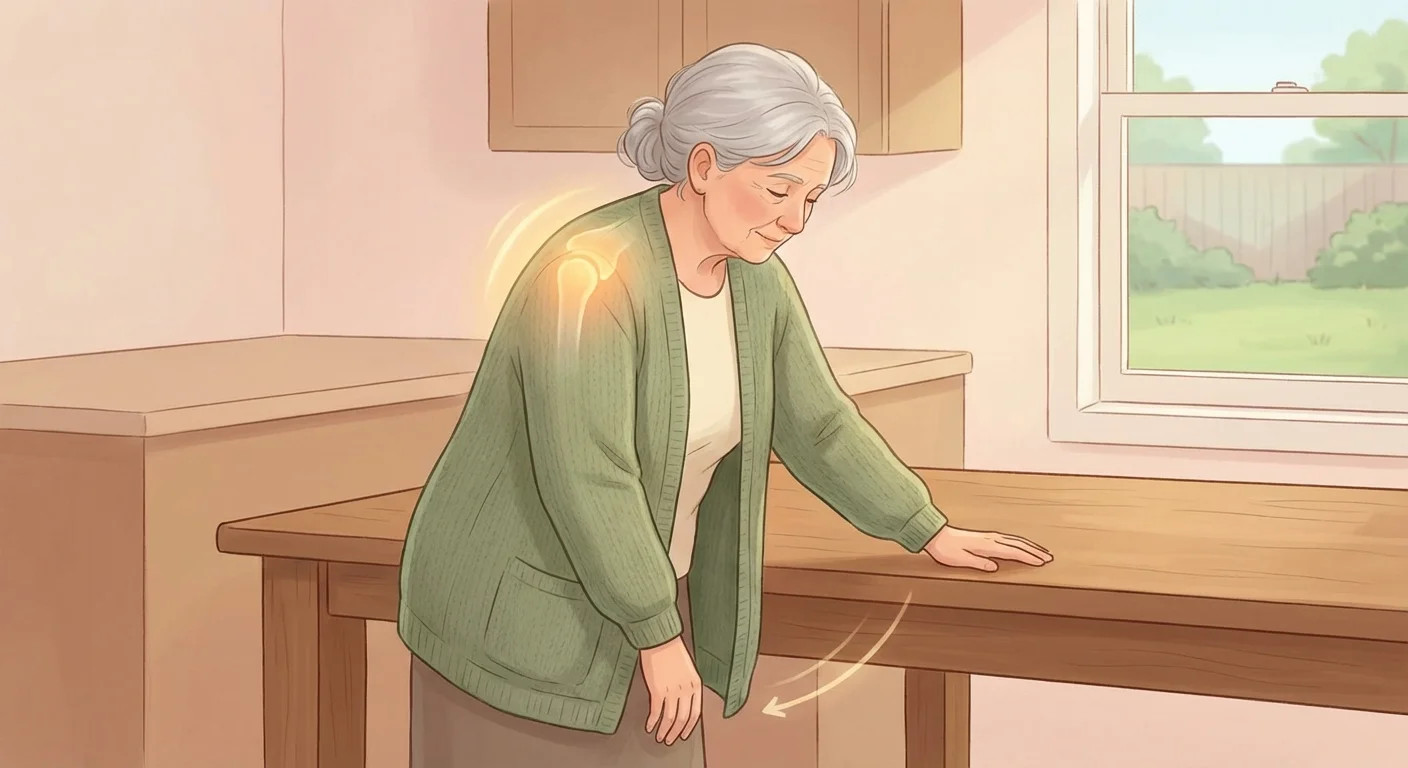
- Lean forward and support yourself with your good arm on a table or countertop
- Let your painful arm hang straight down, completely relaxed
- Gently swing your arm forward and backward (like a pendulum)
- Repeat side to side
- Then make small clockwise circles
- Then counterclockwise circles
- 10 repetitions in each direction
Tips:
- Keep your arm completely relaxed—the movement comes from your body swaying, not from your muscles
- Start with small movements and gradually increase the size as comfort allows
- This should feel soothing, not painful
2. Table Slide (Shoulder Flexion)
Purpose: Improves forward reaching and overhead motion
How to do it:
- Stand facing a table or countertop at waist height
- Place both hands on the table surface
- Slowly walk your fingers forward, sliding your arms ahead of you
- You should feel a gentle stretch in your shoulder
- Hold at your furthest comfortable point for 15-20 seconds
- Walk your fingers back
- Repeat 8-10 times
Progression: As this gets easier, move to a lower surface (like a desk or bed) to increase the stretch.
3. Wall Walk (Shoulder Flexion)
Purpose: Works on overhead reaching ability
How to do it:
- Stand facing a wall, arm’s length away
- Place your fingertips on the wall at shoulder height
- “Walk” your fingers up the wall as high as comfortable
- Hold for 10-15 seconds
- Walk your fingers back down
- Repeat 8-10 times
Tips:
- Move slowly and breathe normally
- Mark the highest point you reach and try to gradually increase it over weeks
- Keep your shoulder relaxed—don’t hike it up toward your ear
4. Doorway Stretch (Shoulder Abduction)
Purpose: Improves ability to lift arm to the side
How to do it:
- Stand in a doorway, sideways to the door frame
- Bend your elbow to 90 degrees
- Place your forearm against the door frame, elbow at shoulder height
- Gently lean your body away from the door frame
- You should feel a stretch across the front and side of your shoulder
- Hold for 30 seconds
- Repeat 3 times per side
Variation: Place your arm at different heights (lower and higher) to stretch different parts of the shoulder.
5. Behind-the-Back Reach
Purpose: Maintains internal rotation needed for dressing, tucking in shirts, fastening bras
How to do it:
- Reach your affected arm behind your back, palm facing outward
- Try to reach up toward your opposite shoulder blade
- Don’t force it—go only as far as comfortable
- You can use your other hand to gently assist
- Hold for 15-20 seconds
- Repeat 5-8 times
Alternative if too difficult: Hold a towel in your good hand behind your back, grasp the bottom with your affected hand, and use the good hand to gently pull upward.
6. Shoulder Rolls
Purpose: Maintains mobility in all directions and reduces stiffness
How to do it:
- Sit or stand with good posture
- Roll both shoulders forward in large circles
- Complete 10 rolls forward
- Then roll backward for 10 repetitions
- Move slowly and smoothly
What you should feel: Gentle movement throughout your shoulder. This often feels good and loosens stiffness.
Strengthening Exercises (Do 3-4 Times Per Week)
Once you’ve established pain-free or low-pain range of motion, add these strengthening exercises. Start with no resistance and gradually add light resistance bands as tolerated.
7. Isometric Shoulder Flexion
Purpose: Strengthens without moving the joint (good for painful days)
How to do it:
- Stand facing a wall, arm’s length away
- Place your palm flat against the wall at shoulder height
- Push into the wall as if trying to lift your arm
- Hold for 5-10 seconds
- Relax
- Repeat 10 times
Tips: You’re not actually moving your arm—you’re just creating tension. This builds strength without joint stress.
8. Scapular Squeezes
Purpose: Strengthens shoulder blade muscles that support the joint
How to do it:
- Sit or stand with good posture
- Imagine trying to squeeze a pencil between your shoulder blades
- Pull your shoulder blades together and slightly downward
- Hold for 5 seconds
- Release slowly
- Repeat 15 times
What you should feel: Muscles working between your shoulder blades, not pain in the shoulder joint itself.
9. External Rotation with Towel
Purpose: Strengthens rotator cuff without equipment
How to do it:
- Hold a rolled towel between both hands at waist level
- Keep your elbows bent at 90 degrees and tucked against your sides
- Pull outward on both ends of the towel simultaneously
- Hold for 5 seconds
- Relax
- Repeat 10-12 times
Progression: Once this is comfortable, progress to a resistance band attached to a doorknob.
10. Shoulder Blade Setting
Purpose: Improves posture and reduces compensatory strain
How to do it:
- Sit with good posture, looking straight ahead
- Gently pull your shoulder blades down and back
- Imagine putting your shoulder blades in your back pockets
- Hold for 10 seconds while breathing normally
- Release
- Repeat 10 times
Benefits: This exercise helps you maintain proper shoulder position throughout the day, reducing unnecessary stress on arthritic joints.
Creating Your Daily Routine
Sample Beginner Routine (15 minutes)
Morning:
- Warm up with moist heat (5 minutes)
- Pendulum swings (2 minutes)
- Table slides (3 minutes)
- Wall walks (3 minutes)
- Shoulder rolls (2 minutes)
Sample Intermediate Routine (20 minutes)
4-5 times per week:
- Warm up (5 minutes)
- All range-of-motion exercises above (10 minutes)
- Scapular squeezes (2 minutes)
- External rotation with towel (2 minutes)
- Gentle stretches (3 minutes)
Sample Advanced Routine (25 minutes)
4-5 times per week:
- Warm up (5 minutes)
- All range-of-motion exercises (10 minutes)
- All strengthening exercises (8 minutes)
- Stretches (5 minutes)
Tips for Success
Make It Easier
- Use heat before, ice after if you have pain or swelling
- Exercise in the morning when stiffness is worst—this sets you up for a better day
- Break it up if 20 minutes is too long; do 10 minutes twice daily
- Use pain medication strategically taking it 30-45 minutes before exercise if needed
Track Your Progress
Keep a simple log noting:
- Which exercises you did
- How many repetitions
- Pain level before and after (scale of 1-10)
- Any positions or movements that felt particularly good or bad
Expect gradual improvement: Most people notice less pain and better function within 4-6 weeks of consistent exercise.
Know When to Modify
Reduce intensity if:
- Pain increases during or after exercise
- You have new swelling
- You feel sharp, catching pain
- Pain persists for more than 30 minutes after exercise
Take a day off if:
- You’re having a bad pain flare
- You have signs of infection (fever, red, hot, swollen joint)
- You had a recent injury
Resume gently when you feel better.
What to Avoid
These activities often aggravate shoulder arthritis:
- Heavy lifting or carrying (overhead or in front)
- Repetitive overhead reaching
- Throwing motions
- Sudden, jerking movements
- Sleeping on the affected shoulder
- Staying in one position too long (like computer work)
- Overdoing exercise on good days (leads to flares)
When to Seek Help
See a physical therapist if:
- You’re not sure you’re doing exercises correctly
- You’re not improving after 6 weeks
- Pain is getting worse despite appropriate exercise
- You’re having trouble incorporating exercises into daily life
See your doctor if:
- Pain is severe or worsening rapidly
- You develop new weakness
- Night pain prevents sleep despite medication
- Your shoulder becomes red, hot, or swollen
- You can’t perform daily activities despite exercise
Complementary Strategies
Exercise works best when combined with other treatments:
Pain Management
- Over-the-counter NSAIDs (if cleared by your doctor)
- Topical pain creams
- Ice after activity if swollen
- Heat before activity for stiffness
Injection Therapy
- Cortisone injections can reduce inflammation, making exercise more tolerable
- Hyaluronic acid injections may provide longer-lasting relief
- Often used to “jump-start” a physical therapy program when pain limits exercise
Activity Modification
- Use your non-affected arm for heavy tasks when possible
- Arrange frequently used items at waist to chest height
- Use long-handled tools to avoid overhead reaching
- Take breaks every 30 minutes if doing repetitive tasks
Sleep Positioning
- Don’t sleep on your painful shoulder
- Use pillows to support your arm
- Try sleeping in a recliner if lying flat is uncomfortable
Real-World Success Story
Margaret, 67, with Stage 2-3 shoulder arthritis:
“When I started, I could barely reach overhead to get a coffee mug from the cabinet. My doctor wanted me to try physical therapy before considering injections. I was skeptical—how could exercise help when it hurt to move?
But I committed to doing the exercises every morning after my shower. The first two weeks were tough. I didn’t see much improvement and wanted to quit. But by week four, I noticed I could reach a little higher. By week eight, I could get that coffee mug down without wincing.
Six months later, I still do these exercises most days. I’m not 100%—I still have arthritis—but I can do my own hair, reach into the back seat of my car, and play with my grandkids without constant pain. It’s made a huge difference in my quality of life.”
The Bottom Line
Shoulder arthritis doesn’t have to control your life. While you can’t reverse the condition, you can significantly reduce pain and maintain function through consistent, appropriate exercise.
Remember:
- Start gently and progress slowly
- Consistency matters more than intensity
- Range-of-motion exercises are the foundation
- Pain should be mild (3-4 out of 10), not severe
- Improvement takes 4-6 weeks of regular exercise
- Combine exercise with other treatments for best results
If you’re new to exercise or have severe arthritis, consider working with a physical therapist for the first few sessions to learn proper form and develop a personalized program.
Your shoulder may have arthritis, but with the right approach, you can still maintain the function and independence that matter most to you.
Related Resources
Enjoyed this article?
Get more insights like this delivered to your inbox weekly.
Join 10,000+ readers. No spam.