Balance Exercises to Prevent Falls With Arthritis
Simple balance exercises designed for arthritis patients to prevent falls, improve stability, and build confidence. Safe routines for seniors.
By Joint Pain Authority Team
Key Takeaways
- Falls are the leading cause of injury in adults over 65, and arthritis significantly increases fall risk
- Simple balance exercises done 3-4 times per week can reduce fall risk by up to 40%
- You can start with seated and supported exercises and progress as your confidence grows
- Proprioception — your body’s sense of position — declines with arthritis but can be retrained
- A physical therapist can assess your fall risk and create a personalized balance program
Every year, one in four Americans over age 65 experiences a fall. For people living with knee osteoarthritis, hip arthritis, or ankle osteoarthritis, that number is even higher. Painful, stiff joints weaken the muscles and sensory systems your body depends on to stay upright.
The fear of falling can be just as limiting as the fall itself. Many people stop walking, socializing, or doing activities they love because they’re afraid of losing their balance. But here’s what the research shows: balance exercises work. A meta-analysis in The BMJ found that exercise programs focusing on balance reduced falls in older adults by 23-40%. These exercises are safe, effective, and you can do most of them at home.
Why Arthritis Increases Fall Risk
Understanding why arthritis makes you unsteady helps explain why these exercises matter.
Joint pain changes how you walk. When your knee or hip hurts, you shift your weight to avoid pain. This alters your gait and center of gravity, making you less stable.
Muscle weakness develops. Pain causes you to move less. Less movement leads to muscle loss, especially in the legs and core — the muscles that keep you balanced.
Proprioception declines. Proprioception is your body’s ability to sense where your joints are in space. Damaged joints send weaker signals to your brain, slowing your balance reactions.
Medications can affect balance. Some pain medications, anti-inflammatories, and other drugs can cause dizziness or drowsiness.
Level 1: Supported Standing Exercises
Start here if you feel unsteady. Use a sturdy chair, counter, or wall for support.
Heel-to-Toe Stand
- Stand near a counter with one hand lightly touching it for support
- Place one foot directly in front of the other, heel touching toes
- Hold this position for 10 seconds
- Switch which foot is in front
- Repeat: 5 times per side
Progression: Hold for longer. Then try with just fingertips on the counter. Eventually, try with no hand support.
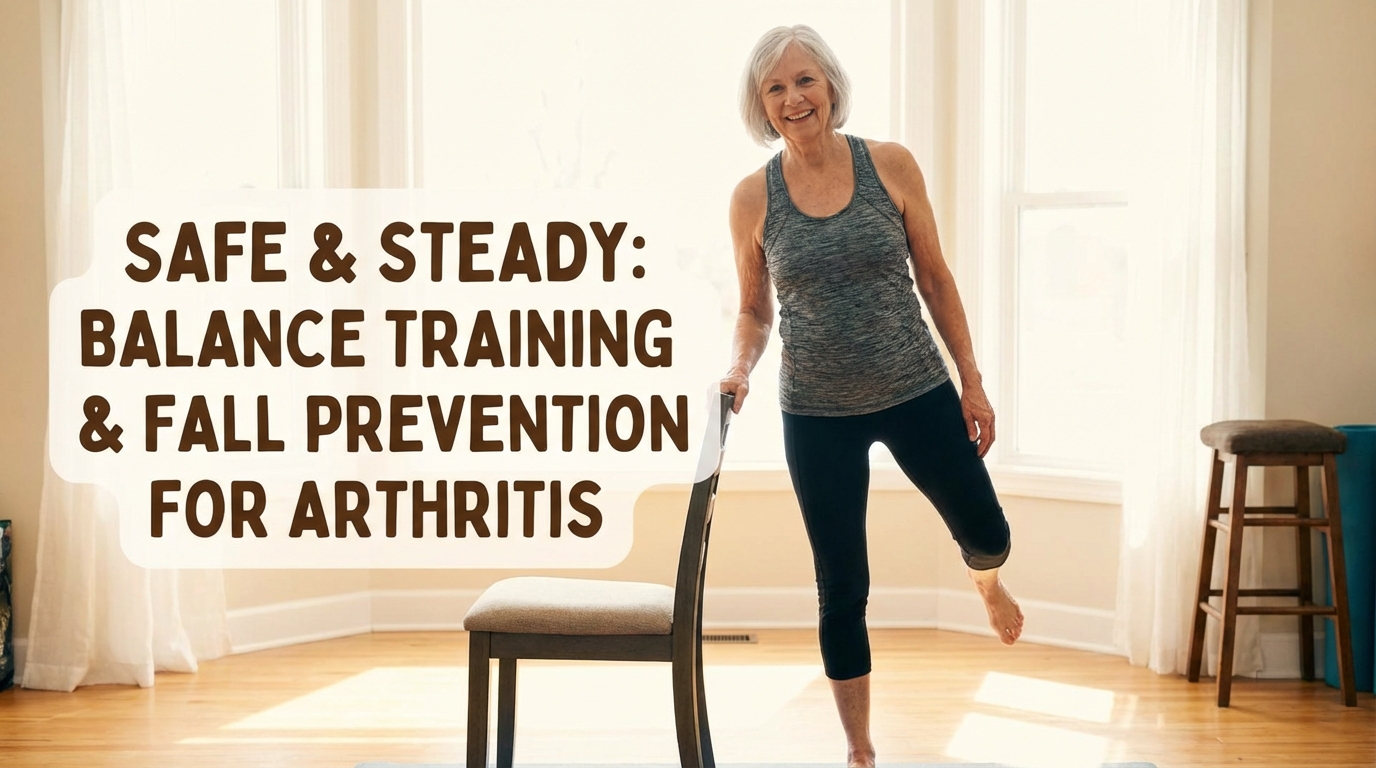
Single-Leg Stand
This is one of the most effective balance exercises backed by research.
- Stand behind a sturdy chair, holding the back lightly
- Lift one foot a few inches off the ground
- Hold for 10 seconds (or as long as you can)
- Lower your foot and switch legs
- Repeat: 5 times per leg
Progression: Hold for 30 seconds. Try with one finger on the chair. Then try with no support.
Weight Shifts
- Stand with feet hip-width apart, one hand on a counter
- Slowly shift your weight to your right foot
- Hold for 5 seconds
- Shift to your left foot
- Hold for 5 seconds
- Repeat: 10 times total
Level 2: Dynamic Balance Exercises
Move to these once you feel confident with Level 1 exercises.
Heel-to-Toe Walk
This exercise trains your balance during actual movement — which is when most falls happen.
- Stand near a wall or hallway (use the wall for support if needed)
- Walk forward placing your heel directly in front of the toes of your other foot
- Take 10 steps forward
- Turn slowly and walk back
- Repeat: 3 times
Marching in Place
- Stand tall near a counter or chair for support
- Lift your right knee toward your chest
- Lower it slowly
- Lift your left knee
- Continue alternating for 30 seconds
- Repeat: 3 sets
Tip: Lift your knees as high as is comfortable. Even a small lift engages your balance system.
Side Steps
- Stand with a counter or wall on one side for support
- Take 10 slow steps to the right, leading with your right foot
- Take 10 slow steps back to the left
- Repeat: 3 times
Why it matters: Side-stepping strengthens the hip abductor muscles, which are critical for stability and often weak in people with hip or knee arthritis.
Level 3: Advanced Balance Challenges
Progress to these only when you can comfortably do Level 2 exercises without support.
Standing on an Unstable Surface
- Stand on a folded towel or thin pillow (near a counter for safety)
- Hold your balance for 15-30 seconds
- Repeat: 5 times
The soft surface challenges your proprioception and forces your ankle and foot muscles to work harder.
Clock Reaches
- Stand on your right leg (hold a chair if needed)
- Imagine you’re standing in the center of a clock
- Reach your left foot forward (12 o’clock), then to the side (3 o’clock), then behind you (6 o’clock)
- Return to center after each reach
- Switch legs
- Repeat: 3 rounds per leg
Sit-to-Stand (No Hands)
- Sit on a sturdy chair with feet flat on the floor
- Cross your arms over your chest
- Stand up using only your leg muscles
- Slowly sit back down with control
- Repeat: 8-10 times
This exercise builds the leg strength you need to recover from stumbles and get up safely if you do fall.
Building Your Balance Routine
Frequency: 3-4 days per week, 10-15 minutes per session.
| Week | Focus |
|---|---|
| 1-2 | Level 1 exercises only, with full hand support |
| 3-4 | Level 1 with reduced support + start Level 2 |
| 5-6 | Mix of Level 1 and 2, less support |
| 7+ | Add Level 3 exercises as comfortable |
Best time: Practice when you feel most alert and steady. Many people prefer mid-morning after any morning stiffness has eased.
Additional Fall Prevention Strategies
Balance exercises are part of a bigger fall prevention picture.
Home safety: Remove loose rugs, improve lighting, install grab bars in bathrooms, and keep walkways clear.
Footwear: Wear supportive, non-slip shoes indoors and out. Avoid walking in socks on smooth floors.
Vision: Get your eyes checked annually. Poor vision is a major fall risk factor.
Bracing and orthotics: An ankle brace or knee sleeve can provide extra stability during exercise and daily activities. Ask your doctor if supportive devices might help.
Physical therapy: A physical therapist can perform a formal fall risk assessment and design a program tailored to your specific weaknesses. Many therapists use the Berg Balance Scale or Timed Up-and-Go test to measure your progress.
Frequently Asked Questions
How quickly can balance exercises reduce my fall risk?
Research shows measurable improvements in balance after just 4 weeks of regular practice. Significant fall risk reduction — up to 40% — typically occurs after 3-6 months of consistent training. The key is practicing regularly, not doing marathon sessions.
Are balance exercises safe if I have severe knee pain?
Yes, as long as you start with supported exercises and listen to your body. Many of the exercises in this guide can be modified for people with significant knee or hip pain. Working with a physical therapist ensures you’re doing exercises appropriate for your pain level.
Should I do balance exercises every day?
Three to four times per week is the sweet spot. Your muscles and nervous system need recovery time to adapt. That said, simple exercises like the single-leg stand while brushing your teeth can be done daily without risk.
What should I do if I start to fall during exercise?
Always exercise near something you can grab — a counter, sturdy chair, or wall. If you feel unsteady, grab your support immediately. There’s no shame in holding on. Safety always comes first.
Can balance exercises help after a joint replacement?
Absolutely. Balance training is a key part of rehabilitation after knee and hip replacement surgery. In fact, many people find their balance improves significantly after replacement because the pain that was disrupting their balance is gone. Your surgeon and physical therapist will guide the timeline.
The information in this article is for educational purposes only and is not intended as medical advice. Always consult with your healthcare provider before starting a new exercise program, especially if you have a history of falls or significant balance problems.
Last medically reviewed: February 2026
Enjoyed this article?
Get more insights like this delivered to your inbox weekly.
Join 10,000+ readers. No spam.