Best Gel Injection for Severe Arthritis (Grade 3-4 OA)
Which gel injection brands have the best evidence for severe knee arthritis? Learn about high molecular weight HA advantages, the Waddell 75% finding, and options for bone-on-bone OA.
By Joint Pain Authority Team
Quick Answer
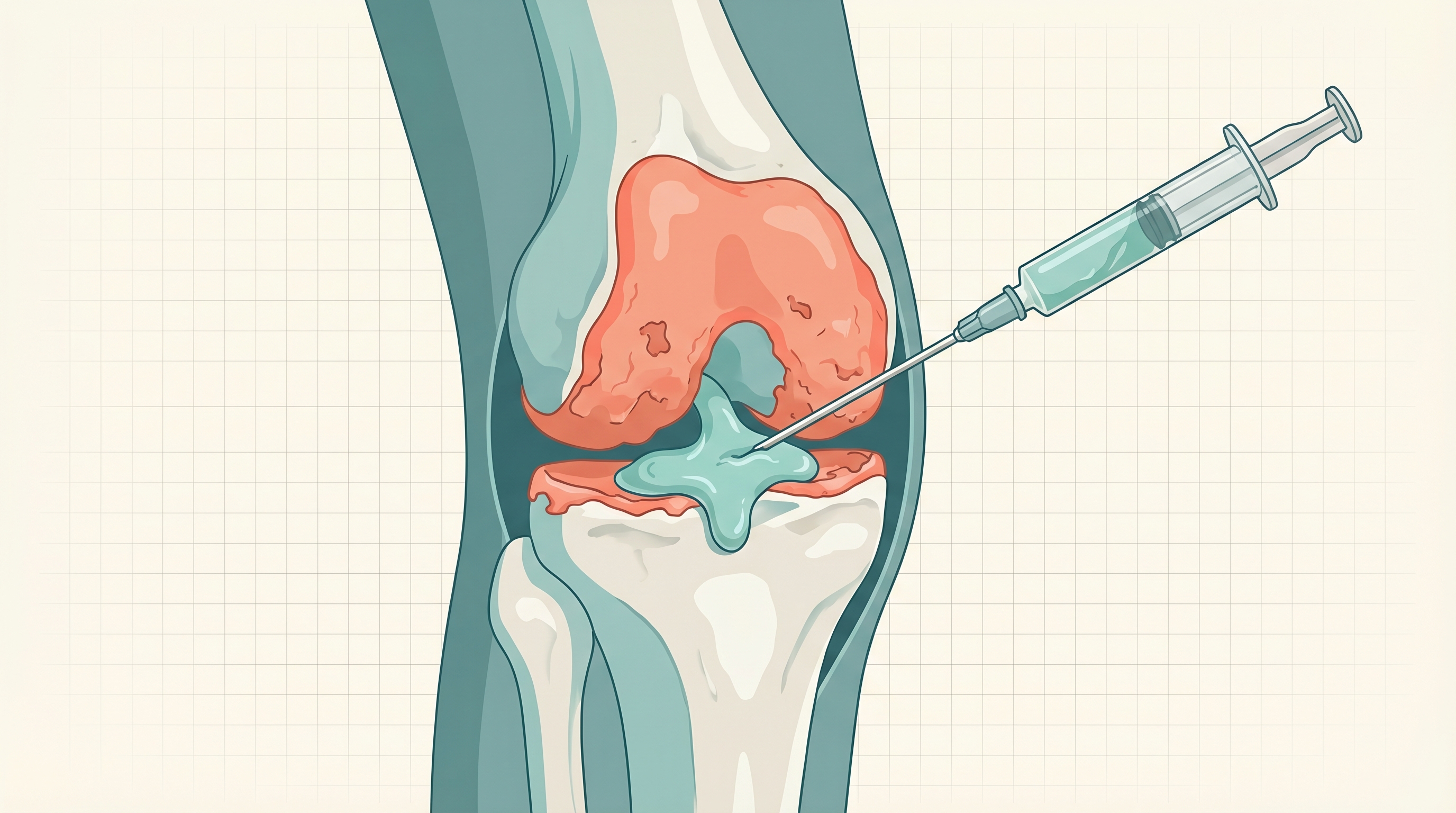
Gel injections can work for severe arthritis, including bone-on-bone (Grade 4) OA. While many patients and even some doctors assume gel injections are only for mild arthritis, the evidence says otherwise:
- 75% of Grade IV OA patients delayed total knee replacement for 7+ years with repeated viscosupplementation (Waddell et al.)
- High molecular weight HA brands (Synvisc-One, Orthovisc, Monovisc) may have an advantage in severe disease due to greater viscosity
- The key factor is not the brand, it is the approach: repeated courses combined with PT and weight management
- Not every severe OA patient responds, but you will not know until you try. A trial of 1-2 courses is medically reasonable before concluding gel injections are not for you.
Understanding Severe Knee Arthritis
The OA Grading System (Kellgren-Lawrence)
| Grade | X-Ray Findings | What It Means |
|---|---|---|
| Grade 1 | Doubtful narrowing, possible osteophytes | Early; you may not even have symptoms yet |
| Grade 2 | Definite osteophytes, possible narrowing | Mild; first symptoms typically appear |
| Grade 3 | Multiple osteophytes, definite narrowing, some sclerosis | Moderate; daily pain is common |
| Grade 4 | Large osteophytes, marked narrowing, severe sclerosis, deformity | Severe; “bone on bone” |
When your doctor says you have “bone-on-bone arthritis,” they typically mean Grade 4: the cartilage cushion is largely or completely gone, and bone surfaces are in direct contact during movement.
Why Many Doctors Say “Gel Injections Won’t Work”
The conventional thinking has been: “If there is no cartilage, there is nothing for the gel to lubricate.” This logic seems intuitive but is incomplete for three reasons:
The Waddell Study: The Most Important Finding
Waddell et al. — Grade IV OA Patients Receiving Viscosupplementation Under Fluoroscopic Guidance
This landmark study specifically looked at patients with the most severe form of knee OA:
- Patient population: Grade IV (bone-on-bone) OA patients
- Treatment protocol: Repeated viscosupplementation courses delivered under fluoroscopic (image) guidance
- Key finding: 75% of patients delayed total knee replacement for 7 or more years
- Implication: Even in the worst-case OA scenario, gel injections can provide meaningful, long-term surgery delay for the majority of patients
Why fluoroscopic guidance matters: In severe OA, the joint space is extremely narrow. Image guidance ensures the injection actually reaches the joint space, which is critical for effectiveness. Without guidance, up to 30% of knee injections may miss the joint, especially in severe OA.
Which Brands Work Best for Severe OA?
The Molecular Weight Advantage
Not all HA products are created equal when it comes to severe arthritis. Research suggests that high molecular weight (HMW) HA may provide greater benefit in advanced disease:
| Molecular Weight Category | Brands | Rationale for Severe OA |
|---|---|---|
| High (>3 million Da) | Synvisc-One, Monovisc, Orthovisc, Gel-One | Greater viscosity provides more cushioning where cartilage is thinnest; longer residence time in the joint |
| Medium (1-3 million Da) | Euflexxa, Durolane, Genvisc 850, Gelsyn-3 | Good viscosity; effective across all grades |
| Low (under 1 million Da) | Hyalgan, Supartz FX | More fluid; may be less effective in severe OA (limited data) |
Important caveat: The molecular weight advantage in severe OA is supported by clinical reasoning and some comparative studies, but no definitive RCT has proven that HMW HA is significantly superior to medium-MW HA specifically in Grade 4 patients. The most important factor is getting treatment at all, not the specific brand.
Brand-by-Brand Evidence for Severe OA
| Brand | Severe OA Data | Notes |
|---|---|---|
| Synvisc-One | Most studied in advanced OA; used in Waddell-type protocols | Cross-linked HMW HA (hylan G-F 20); provides both viscous and elastic properties |
| Orthovisc | High molecular weight with good study data in moderate-to-severe OA | 3-4 injection series; non-avian (bacterial fermentation) |
| Monovisc | High MW single injection; studied across all OA grades | Convenient single-injection format |
| Euflexxa | Studied predominantly in mild-to-moderate OA | Non-avian; fewer studies specifically in Grade 4 |
| Genvisc 850 | Limited published data in severe OA specifically | Cost-effective option; clinical experience suggests similar results to Euflexxa |
| Durolane | NASHA technology; some data in advanced OA | Only non-avian single-injection option |
What to Expect with Severe OA
Response Rates
Response rates are generally lower with severe OA compared to mild-moderate disease, but still meaningful:
| OA Grade | Expected Response Rate | Average Pain Reduction | Duration of Relief |
|---|---|---|---|
| Grade 2 | 70-80% | 40-60% | 6-12 months |
| Grade 3 | 60-70% | 30-50% | 4-8 months |
| Grade 4 | 40-60% | 20-40% | 3-6 months |
Even at Grade 4: 40-60% of patients respond meaningfully. A 20-40% pain reduction may not sound dramatic, but for someone living with constant severe pain, it can mean the difference between being able to walk to the mailbox and being housebound.
Timeline for Results
- Weeks 1-2: May experience temporary increased soreness (injection reaction)
- Weeks 2-4: Gradual improvement begins
- Weeks 4-8: Peak benefit typically achieved
- Months 3-6: Sustained relief in responders
- Month 6+: Consider repeat treatment if initial course was effective
Maximizing Results in Severe OA
Severe Arthritis Treatment Updates
Get evidence-based information about managing advanced knee arthritis without surgery.
Join 10,000+ readers. No spam.
When Gel Injections Are Not Enough
Gel injections may not provide adequate relief for severe OA patients who:
In these cases, total knee replacement may be the appropriate next step. Gel injections are not about avoiding surgery at all costs. They are about ensuring you have explored your options before making an irreversible decision.
The Case for Trying Gel Injections First
Even if you have Grade 4 OA, there are compelling reasons to try gel injections before committing to surgery:
| Reason | Explanation |
|---|---|
| Low risk | Gel injections have minimal side effects. The worst case is that they do not work. They do not make your knee worse or affect future surgical outcomes. |
| Low cost | One course of gel injections costs $100-$350 out of pocket with Medicare. Surgery costs $30,000-$50,000+. |
| Quick to try | You will know within 4-8 weeks whether gel injections help you. Surgery requires 3-6 months of recovery. |
| Reversible | If injections do not work, you can proceed to surgery. If surgery does not go well, you cannot un-operate. |
| 75% success rate | The Waddell data shows 3 out of 4 severe OA patients delayed surgery for 7+ years. Those are good odds. |
Frequently Asked Questions
Can gel injections work if I am truly “bone on bone”?
Yes, for many patients. The Waddell study specifically studied Grade IV (bone-on-bone) patients and found 75% delayed surgery for 7+ years. HA provides benefits beyond lubrication: anti-inflammatory effects, pain signal modulation, and protection of remaining tissue.
Which single brand is best for severe OA?
If forced to choose one, Synvisc-One has the most published data in advanced OA and is the brand used in the Waddell-type fluoroscopic protocols. However, Monovisc and Orthovisc are also high molecular weight options with good evidence. Your doctor’s experience matters more than the specific brand.
Should I insist on ultrasound or fluoroscopic guidance?
For severe OA, yes. The joint space is narrow in Grade 3-4 disease, making landmark-guided (blind) injections more likely to miss. Image guidance significantly improves accuracy and outcomes.
How many courses should I try before concluding they do not work?
Most experts recommend trying at least 2 courses (potentially with different brands or molecular weights) before concluding that gel injections are not effective for you. If the first course provides partial relief, a second course with an optimized protocol (image guidance, combined PT) may improve results.
Does my orthopedic surgeon need to give the injection?
No. Gel injections can be given by orthopedic surgeons, rheumatologists, sports medicine physicians, pain management specialists, and some primary care physicians. Providers who specialize in knee injections and use image guidance tend to have the best outcomes, regardless of their specialty.
Will gel injections delay my surgery and make it harder later?
No. Research shows that patients who delay TKR with gel injections have the same surgical outcomes as patients who proceed directly to surgery. Delaying surgery does not make the surgery harder or the recovery worse.
The Bottom Line
Severe OA Does Not Mean Surgery Is Your Only Option
75% of Grade IV OA patients delayed knee replacement for 7+ years with gel injections (Waddell et al.). This is the strongest evidence against the notion that “bone-on-bone means surgery.”
For severe OA patients, we recommend:
- Try at least 1-2 courses of high molecular weight HA (Synvisc-One, Monovisc, or Orthovisc)
- Insist on image-guided injection (fluoroscopy or ultrasound)
- Combine with PT and weight management for best results
- Repeat courses if effective — cumulative benefit increases over time
- Consider surgery if 2-3 courses of optimized treatment fail to provide meaningful relief
The risk of trying gel injections first is minimal. The potential benefit is years of preserved natural joint function.
Find Severe OA Specialists
Connect with providers experienced in treating advanced knee arthritis with image-guided gel injections.
Your information is secure. See our Privacy Policy and Terms of Service.
Thank You!
We've received your request. A provider specialist will contact you within 1-2 business days to help you find the right care.
What happens next?
- 1 We'll verify your insurance coverage
- 2 Match you with quality providers in your area
- 3 Contact you to discuss your options
Questions? Browse our guides:
How to Choose a ProviderReferences
-
Waddell DD, et al. Viscosupplementation under fluoroscopic control in Grade IV OA. J Bone Joint Surg Am.
-
Altman R, et al. HA injections are associated with delay of TKR. PLoS One, 2015;10(12):e0145776.
-
Comprehensive review of viscosupplementation. Orthopedic Reviews. Full Text
-
NCBI StatPearls: Viscosupplementation. NBK602915
-
Injection accuracy with and without imaging guidance. Am J Sports Med, systematic review.
Advanced Arthritis Treatment Updates
Stay informed about non-surgical options for managing severe knee osteoarthritis.
Join 10,000+ readers. No spam.
Related Resources
Enjoyed this article?
Get more insights like this delivered to your inbox weekly.
Join 10,000+ readers. No spam.