Pool Exercises for Hip Arthritis: Water Therapy Guide
Pool exercises for hip arthritis with the strongest evidence of any exercise type (d=1.12 effect size). Specific water exercises, warm vs cold water, and finding a program.
By Joint Pain Authority Team
Quick Answer
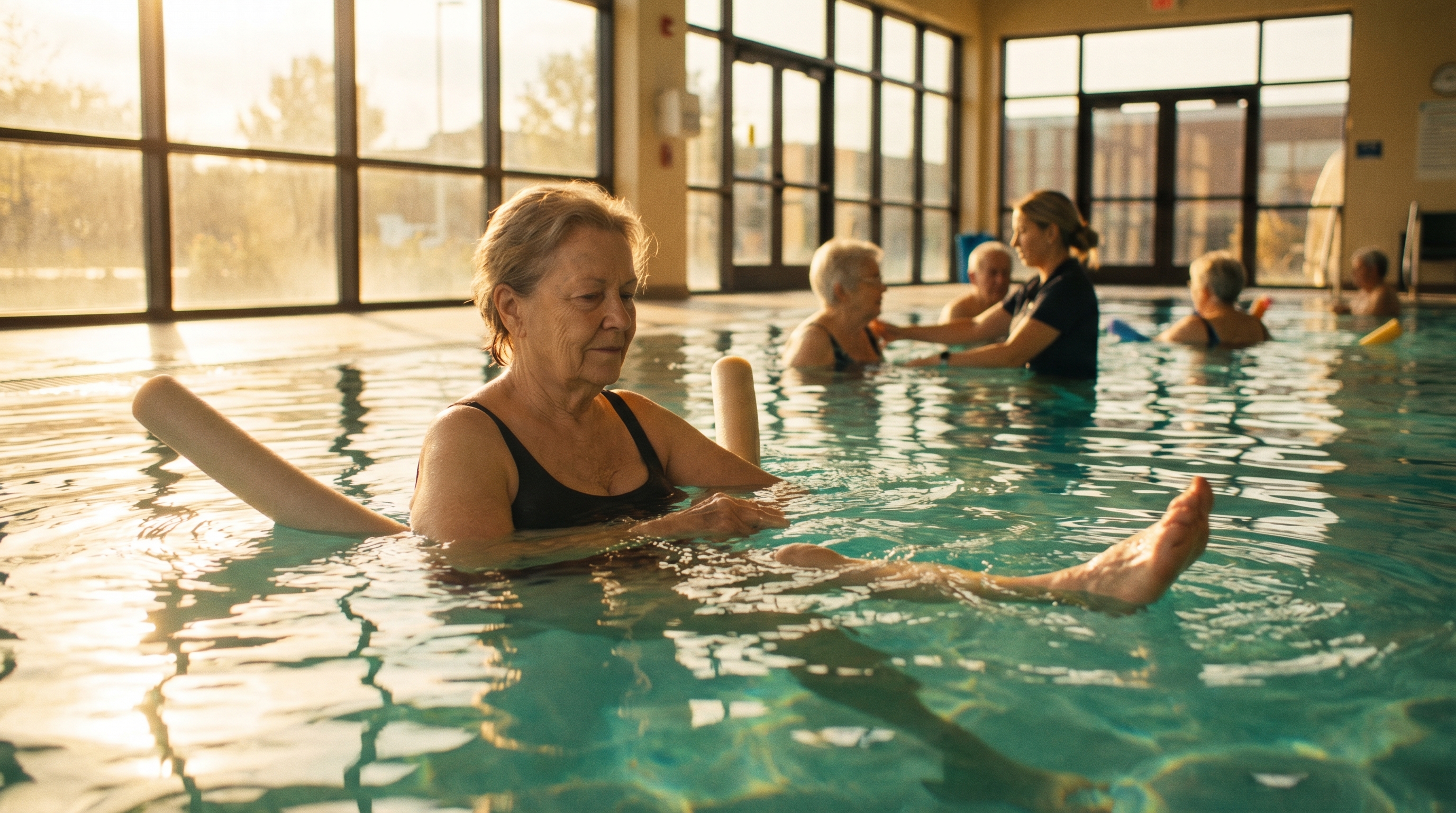
Aquatic exercise has the largest effect size (d=1.12) of any exercise type for hip arthritis pain relief — nearly double the effect of land-based strengthening. Water supports up to 90% of your body weight, making movements nearly pain-free while providing natural resistance for strengthening. Warm therapy pools (83-88 degrees F) offer additional muscle relaxation and pain relief.
Why Water Exercise Is the Best Exercise for Hip Arthritis
If you have tried walking, gym exercises, or stretching and found them too painful, water may be where you can finally exercise comfortably. The evidence is clear: aquatic exercise outperforms every other exercise type for hip arthritis.
A meta-analysis of 13 randomized controlled trials published in Physical Therapy found:
- Pain reduction effect size: d=1.12 (compared to d=0.64 for land-based strengthening)
- Physical function improvement: d=0.91
- Stiffness reduction: d=0.84
To put that in perspective, an effect size of 0.8 is considered “large” in clinical research. The 1.12 for pain reduction means aquatic exercise is producing clinically meaningful improvements for most patients.
A 2023 Cochrane review confirmed these findings, concluding that aquatic exercise “probably results in a large improvement in pain and a large improvement in physical function” for people with hip and knee osteoarthritis.
How Water Helps Your Hip
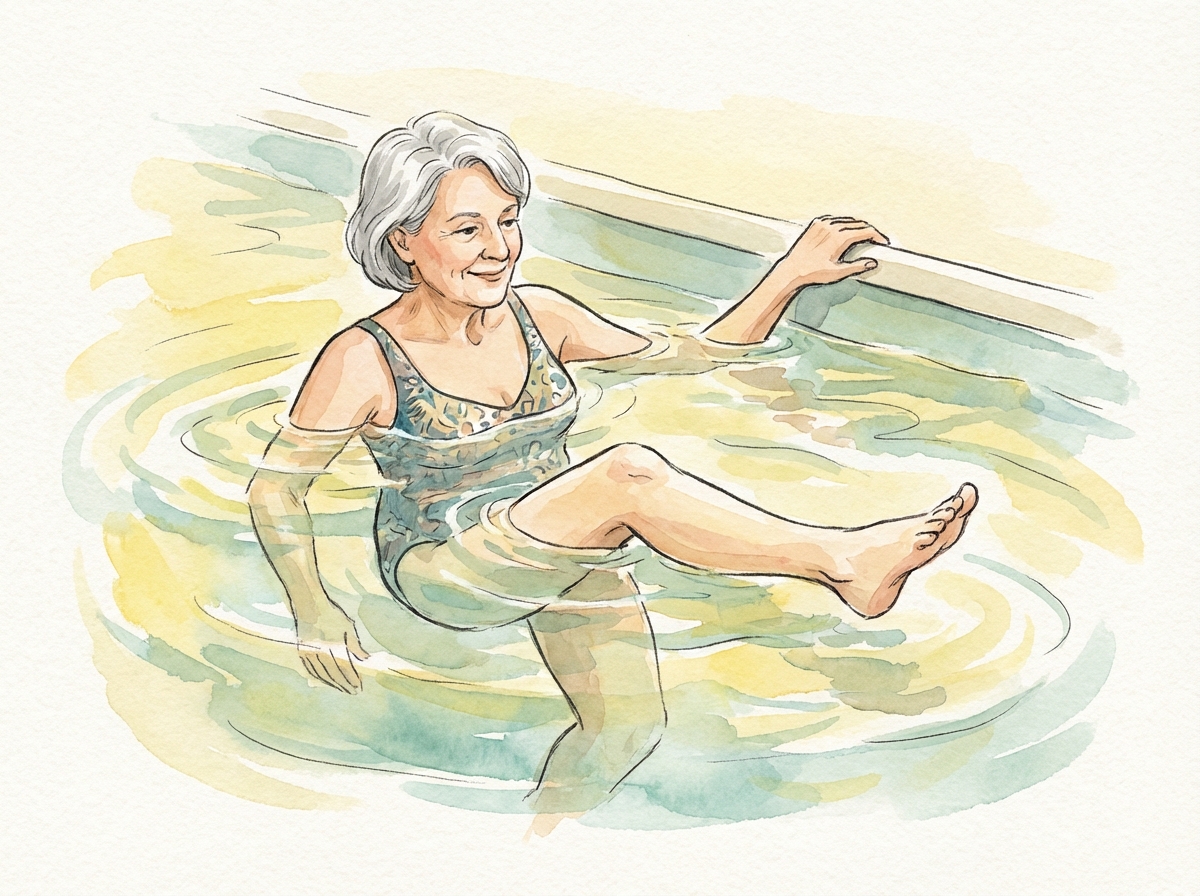
Buoyancy removes weight from the joint. In waist-deep water, buoyancy supports about 50% of your body weight. In chest-deep water, about 80%. In neck-deep water, about 90%. For a 180-pound person, that means their hip bears only 18-90 pounds of load instead of the full 180 — a dramatic reduction that enables pain-free movement.
Warm water relaxes muscles. Therapy pools are heated to 83-88 degrees F. This warmth relaxes the tight muscles around the hip (particularly the hip flexors and IT band), increases blood flow to the joint, and reduces muscle spasm. Many patients report that their hip feels “looser” within the first 5 minutes of immersion.
Water provides 360-degree resistance. Water is about 12 times more resistant than air. Every movement in the pool — forward, backward, sideways — automatically becomes a strengthening exercise. You control the intensity simply by moving faster (more resistance) or slower (less resistance). No weights or equipment needed.
Hydrostatic pressure reduces swelling. The pressure water exerts on your submerged body helps push fluid out of swollen tissues and improves venous return. Many people notice less hip and leg swelling after pool sessions.
Warm Water vs. Cool Water: What the Research Says
| Factor | Warm Therapy Pool (83-88 degrees F) | Standard Lap Pool (78-82 degrees F) |
|---|---|---|
| Pain relief | Superior — warmth adds analgesic effect | Good — buoyancy still helps |
| Muscle relaxation | Excellent — reduces spasm and stiffness | Moderate — may feel tight initially |
| Exercise tolerance | Longer sessions, more range of motion | May need longer warm-up |
| Availability | Hospital rehab, YMCA therapy pools | Public pools, recreation centers |
| Cost | Often covered by insurance (if formal PT) | Usually membership fee only |
A 2020 study in Annals of the Rheumatic Diseases comparing warm water (92 degrees F) to cool water (80 degrees F) exercise for hip OA found that the warm water group had 28% greater pain reduction and 22% greater improvement in hip range of motion after 12 weeks.
Bottom line: Warm water is ideal if available. But exercising in any pool temperature is still far better than no exercise at all.
10 Pool Exercises for Hip Arthritis
Perform these exercises in waist- to chest-deep water. Hold the pool wall for balance as needed.
Exercise 1: Pool Walking (Warm-Up)
The simplest and most effective pool exercise. Walking in water provides gentle hip mobilization and cardiovascular conditioning.
- Walk forward across the pool at a comfortable pace (5 minutes)
- Walk backward to the starting position (5 minutes)
- Walk sideways, leading with your right hip (2 minutes)
- Walk sideways, leading with your left hip (2 minutes)
Total: 10-15 minutes. This alone is therapeutic.
Exercise 2: Standing Hip Abduction
Strengthens the gluteus medius — the muscle most critical for hip stability.
- Stand facing the pool wall, holding the edge for balance
- Slowly swing your right leg out to the side as far as comfortable
- Hold 2 seconds at the top
- Return slowly to center
- Reps: 12-15 per side, 2 sets
Tip: Keep your toes pointing forward and your trunk still. The movement should come from the hip, not from leaning your body.
Exercise 3: Standing Hip Extension
Strengthens the gluteus maximus, essential for walking, stair climbing, and standing up.
- Stand facing the pool wall, hands on the edge
- Slowly swing your right leg straight behind you
- Squeeze your buttock at the end of the movement
- Hold 2 seconds, return slowly
- Reps: 12-15 per side, 2 sets
Caution: Do not arch your lower back. Keep the movement controlled and the range modest.
Exercise 4: Water Squats
Builds strength in hips, knees, and thighs with minimal joint stress.
- Stand with your back against the pool wall, feet shoulder-width apart
- Slowly bend your knees and lower yourself as if sitting in a chair
- Go only as deep as comfortable — even a slight bend counts
- Hold 3 seconds
- Stand back up slowly
- Reps: 10-12, 2-3 sets
Exercise 5: Hip Circles
Improves hip range of motion and distributes synovial fluid across cartilage surfaces.
- Stand on your left leg (hold the wall for balance)
- Lift your right knee to hip level
- Make slow, controlled circles with your knee — 10 clockwise, 10 counterclockwise
- Switch legs
- Sets: 2 per leg
Exercise 6: Forward and Backward Leg Swings
Stretches and strengthens hip flexors and extensors through a full range of motion.
- Stand sideways to the pool wall, holding with one hand
- Swing your outside leg forward and backward in a smooth, pendulum motion
- Let the water’s resistance provide the workout
- Reps: 15-20 swings per leg
- Sets: 2
Exercise 7: Side Leg Swings
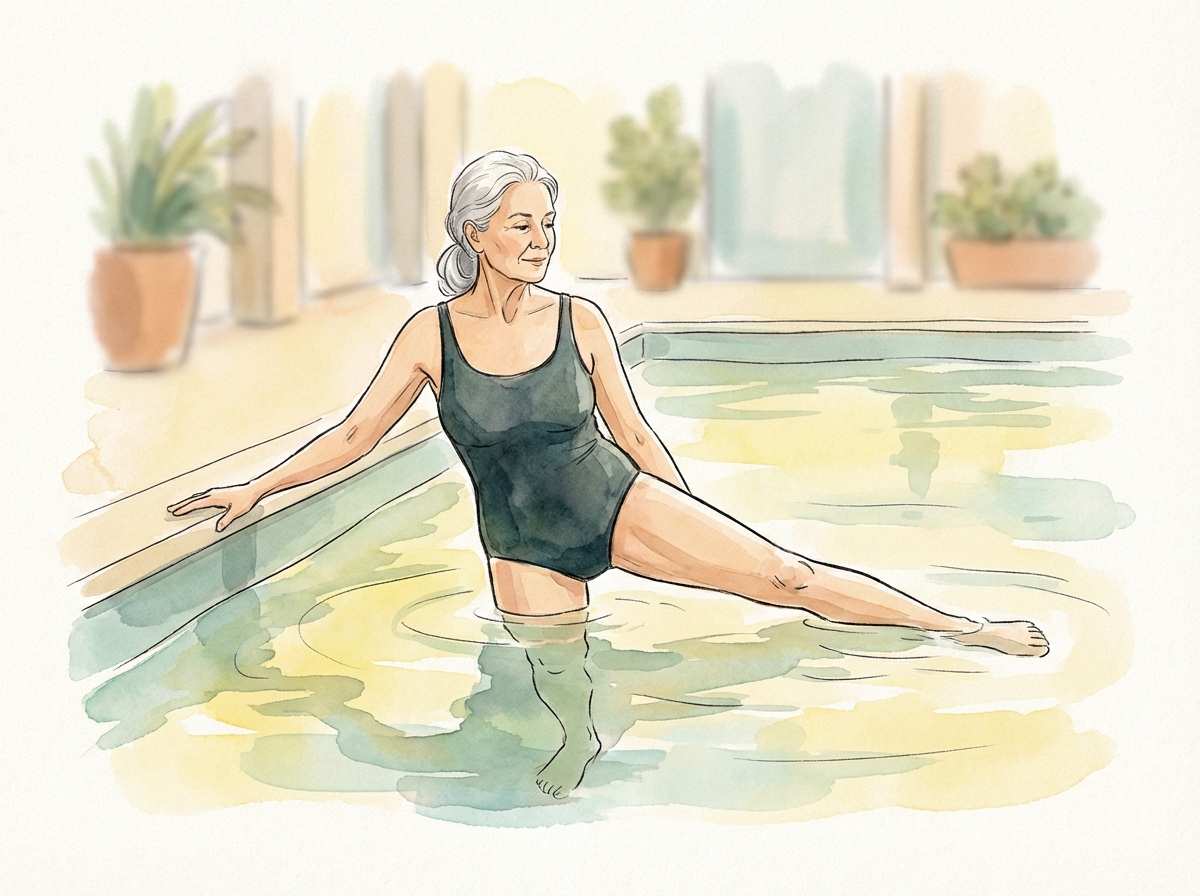
Targets hip abductors and adductors in a comfortable, supported position.
- Stand facing the pool wall, holding the edge
- Swing your right leg across your body (to the left), then out to the right side
- Keep movements smooth and controlled
- Reps: 15-20 swings per leg
- Sets: 2
Exercise 8: Water Marching
Strengthens hip flexors and improves the high-stepping motion needed for stairs and uneven ground.
- Stand in chest-deep water (hold the wall if needed)
- March in place, lifting each knee as high as comfortable
- Pump your arms in opposition (right arm with left leg)
- Duration: 2-3 minutes
- Sets: 2-3
Exercise 9: Pool Hamstring Curl
Strengthens the muscles behind the hip and knee.
- Stand facing the pool wall, hands on the edge
- Slowly bend your right knee, bringing your heel toward your buttock
- The water provides resistance throughout the movement
- Lower slowly
- Reps: 12-15 per leg, 2 sets
Exercise 10: Deep Water Walking or Running
For patients who are comfortable in deeper water, deep water exercise (with a flotation belt) eliminates all impact while providing excellent cardiovascular and muscle conditioning.
- Wear a flotation belt around your waist
- “Walk” or “run” in the deep end with exaggerated leg movements
- The water provides full resistance in every direction
- Duration: 10-20 minutes
Note: You do not need to know how to swim. The belt keeps you upright and above water.
Get your pool exercise plan
Printable aquatic exercise routines for hip arthritis, plus tips for finding programs near you.
Join 10,000+ readers. No spam.
Building a Complete Pool Workout
A well-structured session lasts 30-45 minutes:
| Phase | Exercises | Duration |
|---|---|---|
| Warm-up | Pool walking (forward, backward, sideways) | 10 min |
| Strengthening | Hip abduction, extension, water squats, hamstring curls | 10-15 min |
| Mobility | Hip circles, leg swings, water marching | 5-10 min |
| Cool-down | Slow walking, gentle stretching at the wall | 5 min |
Frequency: 2-3 sessions per week produces optimal results. Allow at least one rest day between sessions. A study in Arthritis Care & Research found that exercising 3 times per week for 12 weeks produced 42% greater improvement than exercising once per week.
Finding a Pool Program Near You
Arthritis Foundation Aquatic Program (AFAP)
The most widely available arthritis-specific water exercise program. Classes are led by trained instructors and designed specifically for people with joint conditions.
- Where: YMCAs, community recreation centers, senior centers, hospital wellness facilities
- Cost: Often free or low-cost ($5-10 per class); some included with gym membership
- Find a class: Visit the Arthritis Foundation website or call 1-800-283-7800
Formal Aquatic Physical Therapy
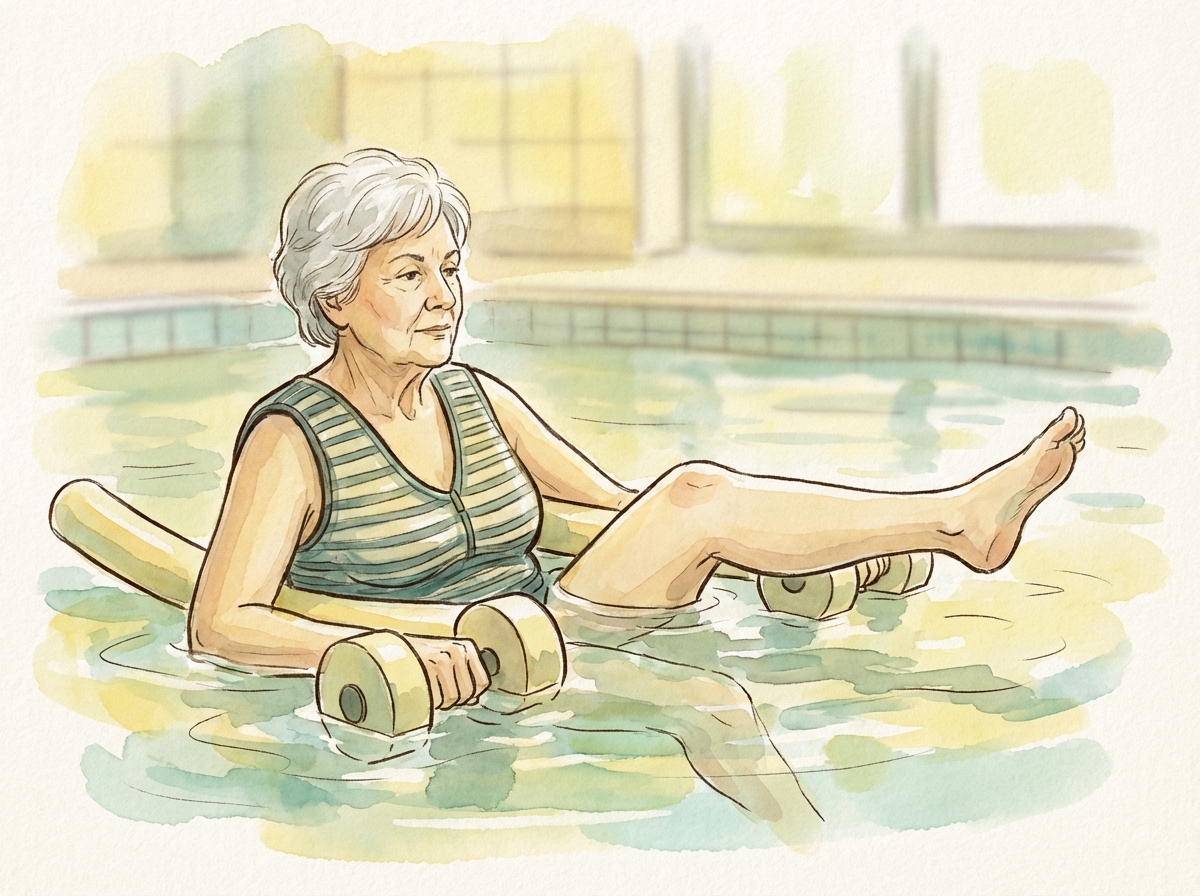
One-on-one or small group physical therapy conducted in a therapy pool by a licensed physical therapist. Your therapist designs exercises specific to your hip condition.
- Insurance: Medicare Part B covers aquatic PT when prescribed by a doctor and provided by a licensed therapist
- Duration: Typically 6-12 sessions, 2-3 times per week
- Best for: Severe hip arthritis, post-injection rehabilitation, patients who need supervised progression
Independent Pool Exercise
Once you have learned proper form (ideally from a class or PT sessions), you can exercise independently in any pool.
Tips for success:
- Water shoes provide traction on slippery pool floors
- Bring a water bottle — you sweat in the pool even though you do not notice it
- Choose off-peak hours for more space and less distraction
- A pool noodle provides additional support for balance exercises
Frequently Asked Questions
Do I need to know how to swim?
No. All exercises in this guide are performed while standing in shallow water (waist to chest depth) with access to the pool wall for balance. You never need to put your face in the water or swim. Many therapy pools also have ramps and handrails for easy entry.
How soon will I notice improvement?
Many people feel immediate relief during their first session — the warm water and buoyancy provide instant comfort. Lasting improvements in pain and function develop over 4-8 weeks of regular sessions (2-3 times per week). A 2022 study found that 78% of participants reported meaningful improvement after 8 weeks of aquatic exercise.
Will my insurance cover aquatic therapy?
Medicare Part B covers aquatic physical therapy when ordered by your doctor and performed by a licensed physical therapist. Medicare Advantage plans may also cover fitness programs (like SilverSneakers) that include pool access. Private insurance coverage varies — call your insurer to verify. Community pool programs and Arthritis Foundation classes are typically self-pay but affordable.
Is pool exercise safe for people with heart conditions?
Water immersion increases blood return to the heart, which can be beneficial but may concern people with heart conditions. A study in the American Journal of Cardiology found that warm water exercise was safe and well-tolerated in patients with stable heart failure. However, always clear aquatic exercise with your cardiologist if you have heart disease.
Can I do pool exercises after hip replacement?
Yes, once your surgical wound has fully healed (typically 3-4 weeks post-surgery). Aquatic therapy is one of the most popular and effective rehabilitation methods after hip replacement. Your surgeon will advise when it is safe to start. The buoyancy allows earlier weight-bearing exercise than land-based rehabilitation.
What is better — pool exercise or land exercise for hip arthritis?
The evidence clearly favors pool exercise for pain reduction (d=1.12 vs. d=0.64 for land strengthening). However, land exercise is more accessible, requires no special facility, and provides weight-bearing stimulus that benefits bone density. The ideal approach combines both: pool exercise for pain relief and land exercise for functional strength. For a comparison of all exercise types, see our best exercises for hip arthritis guide.
The information in this article is for educational purposes only and is not intended as medical advice. Always consult with your healthcare provider before starting aquatic exercise, especially if you have heart conditions, open wounds, or other medical concerns.
Last medically reviewed: April 2026
Enjoyed this article?
Get more insights like this delivered to your inbox weekly.
Join 10,000+ readers. No spam.