Bone on Bone Knee Pain: Complete Treatment Guide
Bone on bone knee pain doesn't always mean surgery. Learn about Kellgren-Lawrence Grade 4, all treatment options, and what research actually shows.
By Joint Pain Authority Team
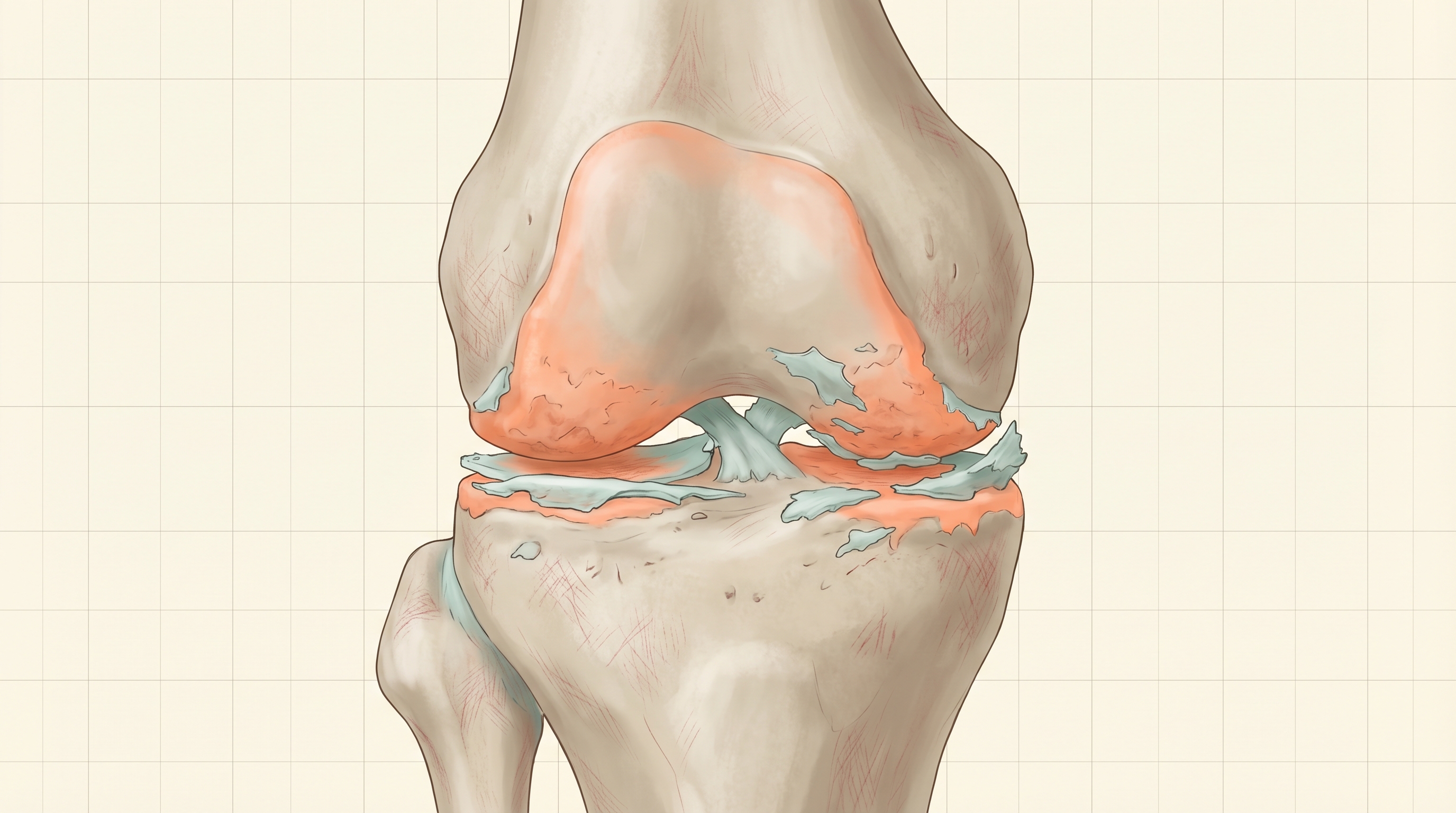
Quick Answer: “Bone on bone” means the cartilage in your knee has worn down significantly, allowing bones to contact each other (Kellgren-Lawrence Grade 4). While this sounds alarming, research shows that many patients with bone-on-bone X-rays manage their pain successfully without surgery through treatments like gel injections, physical therapy, and bracing.
What Does “Bone on Bone” Actually Mean?
If your doctor has told you that your knee is “bone on bone,” they are describing what they see on an X-ray. The smooth, slippery cartilage that normally cushions the ends of your thighbone (femur) and shinbone (tibia) has worn down to the point where the bones appear to touch in certain areas of the joint.
Doctors use a classification system called the Kellgren-Lawrence (KL) grading scale to describe how much cartilage damage an X-ray shows:
- Grade 0: Normal joint, no visible changes
- Grade 1: Doubtful narrowing of the joint space, possible bone spurs
- Grade 2: Definite bone spurs, possible joint space narrowing
- Grade 3: Moderate multiple bone spurs, definite narrowing, some bone hardening
- Grade 4: Large bone spurs, marked narrowing, severe hardening, visible bone deformity
When a doctor says “bone on bone,” they typically mean Grade 4 — the most advanced stage. But here is something most patients are not told: the label describes what an X-ray shows at one moment in time. It does not tell the whole story about your pain, your function, or your treatment options.
The X-Ray Disconnect
One of the most consistent findings in osteoarthritis research is that X-ray severity does not reliably predict how much pain a person feels. A landmark study in the British Medical Journal found that roughly half of people with severe X-ray changes reported minimal symptoms, while some people with mild changes experienced significant pain.
This means two people with identical X-rays can have completely different experiences. One may struggle to walk to the mailbox. The other may play golf three times a week. Your X-ray is one piece of information, not a verdict.
Why Your Knee Reached This Point
Cartilage does not have its own blood supply. It gets nutrients from the synovial fluid that bathes the joint. Over decades, this cartilage gradually breaks down faster than it can repair itself. Several factors accelerate this process:
Age and Wear
The single biggest risk factor is time. After age 50, the water content of cartilage increases, making it softer and more vulnerable to damage. The protein structure weakens. Years of walking, climbing stairs, and daily movement take a cumulative toll.
Body Weight
Every extra pound of body weight adds approximately 4 pounds of force across your knee joint with each step. Over years, this additional mechanical load accelerates cartilage breakdown. Research from Arthritis & Rheumatism shows that losing just 10 pounds reduces the force on each knee by 48,000 pounds per mile walked.
Previous Injuries
A torn meniscus, ACL injury, or fracture involving the knee joint can disrupt the smooth cartilage surface. Even after surgical repair, the joint may never track quite the same way again. Studies show that people with a history of significant knee injury are 4 to 6 times more likely to develop advanced osteoarthritis.
Genetics
Family history plays a meaningful role. If your parents or siblings developed severe knee arthritis, your cartilage may be structurally more vulnerable. Genetic factors account for an estimated 40 to 65 percent of osteoarthritis risk.
Alignment Issues
If your legs are naturally bowed (varus alignment) or knock-kneed (valgus alignment), weight is distributed unevenly across the joint. The overloaded side wears down faster, which is why bone-on-bone changes often affect one compartment of the knee more than others.
Symptoms of Bone on Bone Knee Pain
Advanced cartilage loss produces a recognizable pattern of symptoms. You may experience some or all of the following:
Pain Patterns
- Pain with weight-bearing activities like walking, standing, or climbing stairs that was not there a few years ago
- Pain that worsens throughout the day as activity accumulates
- Pain at rest or at night in more advanced cases, disrupting sleep
- Sharp pain with certain movements like pivoting, twisting, or stepping off a curb
- A deep, aching quality inside the joint that is hard to pinpoint
Stiffness and Mobility Changes
- Morning stiffness lasting 15 to 30 minutes or more
- Stiffness after sitting for extended periods (the “theater sign”)
- Reduced range of motion making it hard to fully bend or straighten the knee
- Difficulty with daily activities like getting in and out of cars, chairs, or bathtubs
Mechanical Symptoms
- Grinding or crepitus — a grating feeling or sound when the knee moves
- Catching or locking — the knee briefly sticks during movement
- Giving way — a feeling that the knee might buckle
- Visible swelling that comes and goes with activity
- Changes in leg alignment — the knee may appear more bowed over time
All Your Treatment Options
The good news is that even with Grade 4 changes on an X-ray, you have a range of treatment options. Research increasingly shows that a combination of approaches often produces the best outcomes. Here is a complete overview, from conservative to surgical.
Conservative and Home-Based Options
These approaches form the foundation of bone-on-bone knee management. They work best in combination.
Exercise and physical therapy remain the single most evidence-supported treatment for knee osteoarthritis at any stage. Targeted strengthening of the quadriceps and hip muscles reduces the load on the joint and improves stability. Low-impact options like swimming, cycling, and walking programs maintain cardiovascular fitness without excessive joint stress.
Weight management produces some of the largest improvements. Research published in JAMA found that combining diet and exercise produced a 51% reduction in pain scores among overweight adults with knee OA. Even modest weight loss of 10 to 15 pounds can meaningfully reduce knee forces.
Home remedies and self-care including ice and heat therapy, topical anti-inflammatory creams, compression sleeves, and activity modification can help manage day-to-day symptoms. These approaches are safe, inexpensive, and can be used alongside other treatments.
Unloader knee braces mechanically shift weight away from the damaged compartment of the knee. For patients with bone-on-bone changes primarily on one side of the joint, an unloader brace can provide immediate relief during walking and standing. Medicare covers these devices with a prescription.
Medical Treatments
Viscosupplementation (gel injections) involves injecting hyaluronic acid into the knee joint to restore lubrication and cushioning. Studies show significant benefit even in advanced osteoarthritis, with 75% of bone-on-bone patients in one study delaying surgery by 7 or more years. Medicare has covered this treatment since 1997. The key to effectiveness is accurate placement using imaging guidance (fluoroscopy or ultrasound).
Corticosteroid injections provide short-term anti-inflammatory relief during flare-ups. They typically work within days and can last several weeks. Doctors generally limit cortisone to 3 to 4 injections per year per joint because of potential effects on remaining cartilage.
Oral medications including acetaminophen, NSAIDs like ibuprofen and naproxen, and prescription options like duloxetine (Cymbalta) can help manage pain. Each has benefits and limitations that should be discussed with your doctor based on your overall health profile.
PRP (platelet-rich plasma) injections use concentrated platelets from your own blood. Early research suggests potential benefits for cartilage health, though evidence for advanced OA is still developing. PRP is generally not covered by insurance.
Surgical Options
Knee replacement surgery is the definitive surgical treatment when conservative options no longer provide adequate relief. Total knee replacement (TKR) involves replacing the damaged joint surfaces with metal and plastic components. Partial knee replacement replaces only the damaged compartment and may be an option when bone-on-bone changes are limited to one area.
Knee replacement is a major surgery with a typical recovery of 3 to 6 months. Modern implants last 15 to 25 years in most patients. For people whose pain significantly limits their quality of life despite exhausting conservative options, it can be life-changing.
Osteotomy involves cutting and reshaping the bone to shift weight away from the damaged area. This is less common today but may be appropriate for younger, active patients with damage limited to one compartment.
Treatment Without Surgery: What the Research Shows
A growing body of research challenges the idea that bone-on-bone automatically means you need a knee replacement. Several important findings have emerged:
The surgery delay data. A large database analysis published in Osteoarthritis and Cartilage found that patients who received viscosupplementation delayed knee replacement by an average of 3.6 years compared to those who did not. Among the most severely affected patients, many delayed surgery by 7 or more years.
The exercise evidence. The 2019 OARSI guidelines for non-surgical management of knee OA gave their strongest recommendation to exercise and physical therapy, regardless of disease severity. A Cochrane review of 54 trials confirmed that exercise reduces pain and improves function in knee OA.
The combination approach. Research consistently shows that no single treatment works as well alone as a combination of approaches. The patients who do best typically combine structured exercise, weight management, appropriate medical treatments, and assistive devices.
When to Consider Surgery
Conservative treatment is not right for everyone, and knee replacement surgery can be an excellent option for the right patient. Consider surgical evaluation if:
- Pain significantly limits your daily activities despite 3 to 6 months of comprehensive conservative treatment
- You cannot sleep due to knee pain
- You can no longer do the things that matter most to you
- Your quality of life has declined substantially
- You have tried imaging-guided injections, completed physical therapy, and used appropriate bracing
The decision is personal. There is no X-ray finding that requires surgery. It comes down to how the knee affects your life and whether you have genuinely exhausted non-surgical options.
When to See a Doctor
Schedule an appointment with a healthcare provider if you experience any of the following:
- Knee pain that has been present for more than 2 weeks and is not improving
- Pain that prevents you from doing normal daily activities
- Knee swelling, warmth, or redness that develops suddenly
- A feeling that your knee locks, catches, or gives way
- Pain that wakes you from sleep
- Difficulty walking more than a few blocks
- Any sudden change in your knee pain pattern
A thorough evaluation should include a physical examination, standing X-rays, and a discussion of all your treatment options — not just surgery.
Frequently Asked Questions
What does bone on bone in the knee feel like?
Bone-on-bone knee pain typically presents as a deep ache inside the joint that worsens with activity. You may feel grinding or hear a grating sound when you move the knee. Stiffness is common, especially in the morning or after sitting for a while. Many people first notice it on stairs before it affects walking on flat ground. The pain may come and go early on, but tends to become more persistent over time.
Can you walk with a bone on bone knee?
Yes. Many people with bone-on-bone X-ray findings continue to walk regularly. Research shows that appropriate walking programs actually benefit knee osteoarthritis by maintaining muscle strength, joint flexibility, and overall fitness. The key is finding the right intensity and duration for your specific situation, using supportive footwear, and supplementing walking with other treatments as needed.
How long can you live with bone on bone knees without surgery?
There is no set timeline. Some people manage bone-on-bone arthritis for years or even decades using conservative treatments. The research on viscosupplementation shows that many patients delayed knee replacement by 7 or more years. Your outcome depends on factors like body weight, activity level, muscle strength, and which treatments you use. Bone-on-bone does not automatically get worse over time in every person.
Does Medicare cover treatment for bone on bone knees?
Yes. Medicare covers many treatments for advanced knee osteoarthritis including viscosupplementation (gel injections) since 1997, physical therapy, corticosteroid injections, unloader braces, and knee replacement surgery when it becomes necessary. The specific coverage details depend on your plan, so it is worth verifying with your Medicare provider. Visit our Medicare coverage guide for detailed information.
Is bone on bone arthritis the worst stage?
Bone on bone corresponds to Kellgren-Lawrence Grade 4, which is the most advanced stage on the X-ray grading scale. However, “worst stage” on X-ray does not mean “worst pain” or “worst function.” As discussed above, there is a well-documented disconnect between what the X-ray shows and how a person actually feels. Many people with Grade 4 findings have moderate symptoms that respond well to conservative treatment.
Get Your Bone on Bone Treatment Options Guide
Evidence-based information about managing severe knee arthritis. Weekly updates on treatments, Medicare coverage, and living well with knee pain.
Join 10,000+ readers. No spam.
References
- Kellgren JH, Lawrence JS. Radiological assessment of osteo-arthrosis. Annals of the Rheumatic Diseases. 1957;16(4):494-502.
- Hannan MT, et al. Analysis of the discordance between radiographic changes and knee pain in osteoarthritis of the knee. Journal of Rheumatology. 2000;27(6):1513-1517.
- Altman RD, et al. Analysis of a large US claims database to determine if TKR is delayed by viscosupplementation. Osteoarthritis and Cartilage. 2015.
- Bannuru RR, et al. OARSI guidelines for the non-surgical management of knee osteoarthritis. Osteoarthritis and Cartilage. 2019.
- Fransen M, et al. Exercise for osteoarthritis of the knee: a Cochrane systematic review. British Journal of Sports Medicine. 2015;49(24):1554-1557.
- Messier SP, et al. Effects of intensive diet and exercise on knee joint loads, inflammation, and clinical outcomes among overweight and obese adults with knee osteoarthritis. JAMA. 2013;310(12):1263-1273.
Topics
Enjoyed this article?
Get more insights like this delivered to your inbox weekly.
Join 10,000+ readers. No spam.