Protecting Your Joints During Daily Activities
Practical tips for protecting joints during cooking, gardening, cleaning, and errands. Body mechanics, pacing, and assistive devices that reduce strain.
By Joint Pain Authority Team
Quick Answer
Joint protection is about working smarter, not harder. Small changes in how you perform daily tasks can significantly reduce joint stress and pain. Key principles include using larger joints and stronger muscles for heavy tasks, maintaining good posture and body mechanics, pacing activities throughout the day, and using assistive tools where helpful. These strategies help you stay independent and active while preserving joint function.
Why Joint Protection Matters
Every activity you do throughout the day places forces on your joints. For someone with healthy cartilage, these forces are easily absorbed. But with arthritis, where cartilage is thinned and inflammation is present, the same activities can cause pain and accelerate joint damage.
Joint protection does not mean avoiding activity. In fact, staying active is essential for joint health. Joint protection means modifying how you do things so that you accomplish the same tasks with less strain on vulnerable joints.
Occupational therapists specialize in joint protection strategies, and research shows that patients who consistently apply these principles report less pain, better function, and greater independence over time.
Core Joint Protection Principles
Before the specific tips, understand these five principles that apply to every activity:
1. Respect Pain
Pain is a signal. If an activity causes sharp pain or pain that lasts more than 2 hours afterward, modify the activity or take a break. Pushing through pain does not build toughness. It damages cartilage.
2. Use Your Strongest Joints and Muscles
When possible, use larger joints instead of smaller ones:
- Carry bags over your forearm or shoulder instead of gripping with your fingers
- Push heavy doors with your hip or shoulder instead of your hand
- Lift with your legs and hips instead of bending at the waist
3. Distribute Forces Across Multiple Joints
Spreading the load reduces stress on any single joint:
- Use both hands to lift a pot instead of one
- Carry loads close to your body instead of at arm’s length
- Slide objects across a counter instead of lifting them
4. Avoid Staying in One Position Too Long
Static positions (holding a grip, standing still, sitting without moving) are hard on arthritic joints. Change positions frequently. If you have been sitting for 30 minutes, stand and walk briefly. If you have been standing, sit down.
5. Pace Yourself
Alternate heavy and light tasks. Do not save all your errands for one marathon day. Spread demanding activities across the week and build in rest between tasks.
Kitchen and Cooking
The kitchen involves gripping, twisting, standing, and repetitive movements, all of which can stress arthritic joints.
Reducing grip strain:
- Use electric can openers and jar openers instead of manual ones
- Choose utensils with thick, cushioned grips (or add foam tubing to regular utensils)
- Use a rubber grip pad to open jars. Place the jar on the pad, press down, and twist. The rubber does the work.
- Opt for lightweight pots and pans. Cast iron is heavy. Consider ceramic-coated aluminum.
Reducing standing time:
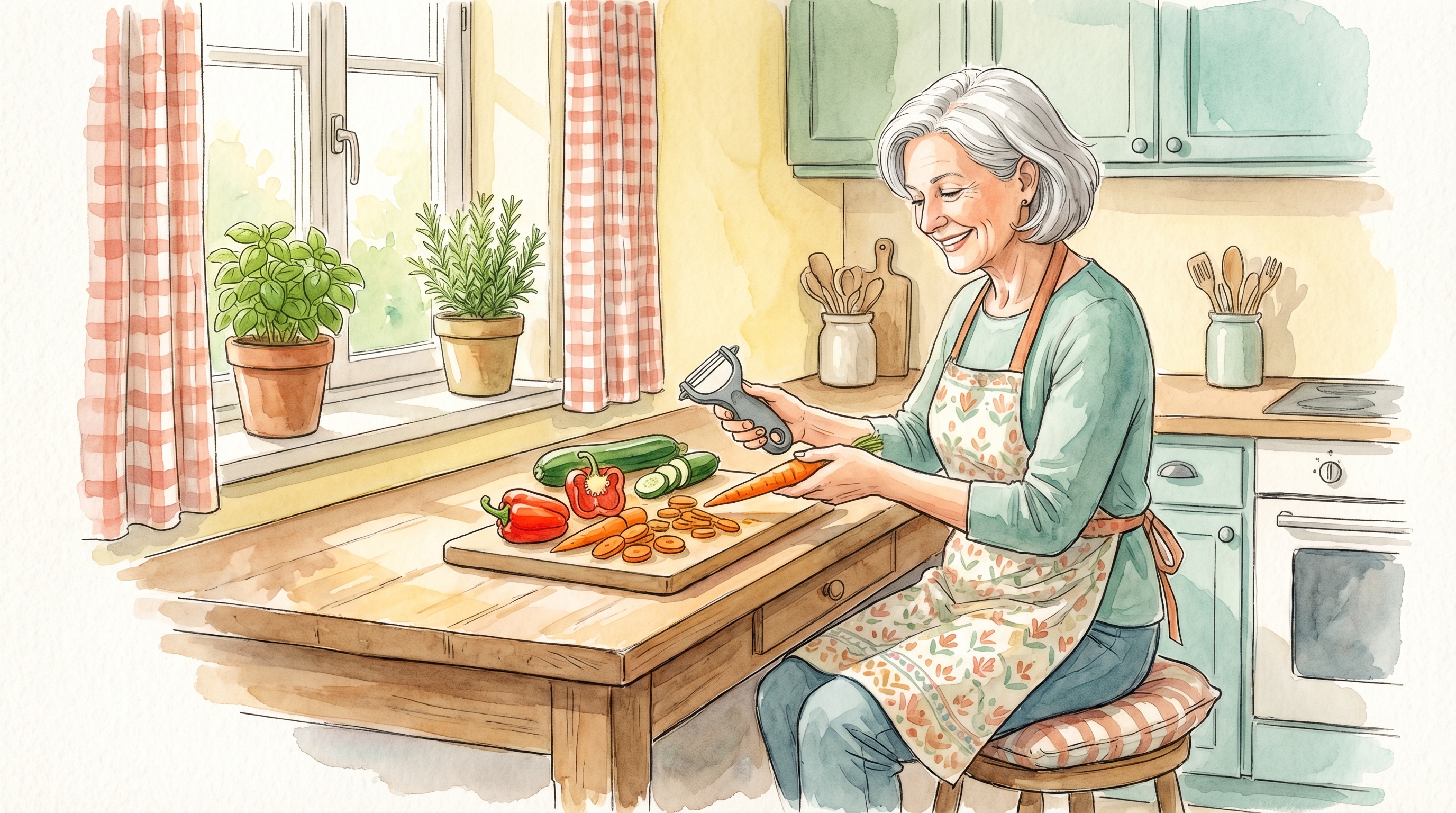
- Use a high stool at the counter so you can alternate between sitting and standing while preparing food
- Organize your kitchen so frequently used items are between waist and shoulder height. Avoid reaching overhead or bending to low cabinets repeatedly.
- Prepare meals in stages. Chop vegetables in the morning while sitting, cook in the evening.
Reducing lifting:
- Slide pots of water across the counter to the stove instead of carrying them
- Use a colander that sits in the pot so you can tip the pot slowly into the sink instead of lifting heavy water
- Fill pots using a lightweight pitcher at the stove instead of carrying a full pot from the sink
Tools that help:
- Rocker knives (cut with a rocking motion instead of a sawing grip)
- Ergonomic peelers with large handles
- One-touch electric appliances (food processors, electric kettles)
- Lightweight baking sheets with silicone grips
For more kitchen-specific tools, see our guide to ergonomic tools for arthritis.
Gardening
Gardening is one of the activities most commonly abandoned by people with arthritis, which is unfortunate since time outdoors and gentle activity are beneficial for joint health.
Knee protection:
- Use a kneeling pad or garden stool with handles to help you stand up
- Raised garden beds eliminate the need to kneel at all
- Long-handled tools allow you to work while standing
- Limit kneeling to 10-15 minute sessions, then stand and walk briefly
Hand and wrist protection:
- Use ergonomic garden tools with padded, angled handles
- Wear padded gardening gloves that reduce vibration and grip force
- Choose tools with ratchet mechanisms (like ratchet pruners) that reduce the force needed
- Avoid prolonged gripping. Set the tool down periodically and open and close your hands.
General pacing:
- Garden for 20-30 minutes, then rest for 10 minutes
- Alternate tasks (10 minutes of weeding, 10 minutes of watering, 10 minutes of light pruning)
- Do heavy tasks like digging on separate days from lighter tasks
- Garden during cooler morning hours when joints are typically less swollen
For a complete guide, see our article on gardening with joint pain.
Joint Protection Toolkit
Download our printable joint protection checklist for kitchen, bathroom, and garden activities.
Join 10,000+ readers. No spam.
Bathroom
The bathroom involves some of the most challenging movements for people with knee, hip, and hand arthritis.
Getting on and off the toilet:
- A raised toilet seat (adds 3-5 inches of height) reduces the depth of the squat
- Toilet safety frames with armrests provide leverage to stand without straining your knees
- Push up with your palms on the armrests, not your fingers
Bathing:
- A shower bench or transfer bench allows you to sit while showering
- Grab bars (wall-mounted, not suction cups) provide safe support for standing and transfers
- A handheld showerhead on a flexible hose lets you shower while seated
- Use a long-handled sponge or brush to reach your back and lower legs without bending
Personal care:
- Electric toothbrushes reduce the grip force needed for brushing
- Pump bottles for soap and shampoo are easier than squeeze bottles
- A sock aid helps pull on socks without bending to your feet
- Long-handled shoe horns eliminate the need to bend for shoes
Cleaning and Household Tasks
Vacuuming and mopping:
- Lightweight stick vacuums or robot vacuums reduce the pushing and pulling force
- Use long-handled mops and dusting wands to avoid bending
- Do one room per day instead of the entire house at once
- Switch hands periodically to distribute strain
Laundry:
- Front-loading washers avoid reaching into a top-loading tub
- A raised platform under the washer/dryer reduces bending
- Fold laundry at counter height (a folding table) instead of bending over a bed
- Use a rolling laundry cart instead of carrying baskets
General cleaning:
- Spray cleaners are easier than scrubbing with force
- Microfiber cloths clean effectively with less pressure
- Use step stools with handrails instead of reaching overhead
- Break tasks into 15-20 minute segments with rest between
Shopping and Errands
Grocery shopping:
- Use a shopping list organized by store section to minimize backtracking
- Request help with heavy items or delivery for large orders
- Use the cart for support (leaning lightly on it while walking)
- Bag groceries lightly so no single bag is too heavy
- Make two light trips from the car instead of one heavy trip
Driving:
- Use a key turner or push-button ignition
- Adjust mirrors and seats before driving to avoid twisting
- A steering wheel cover with a thicker grip reduces hand strain
- For long drives, stop every 30-45 minutes to walk and stretch
Body Mechanics for Lifting
Proper lifting technique protects your knees, hips, and back simultaneously:
- Stand close to the object you are lifting
- Bend at the knees and hips, not the waist
- Keep the object close to your body as you lift
- Tighten your core before lifting
- Lift with your legs, straightening your knees and hips together
- Do not twist while carrying. Turn your entire body by pivoting your feet.
- If it feels too heavy, it is. Get help or use a cart.
For loads you move regularly (groceries, laundry, grandchildren), invest in a small folding utility cart. The $30 investment saves your joints thousands of times over.
When to Consider Occupational Therapy
An occupational therapist (OT) can evaluate your specific home, activities, and limitations and create a customized joint protection plan. Consider a referral if:
- Joint pain is limiting your daily independence
- You have had to give up activities you enjoy
- You are unsure how to modify tasks safely
- You want a professional assessment of your home for adaptive equipment
- Physical therapy has helped with exercise but you need help with daily task strategies
Medicare and most insurance plans cover occupational therapy when prescribed by a physician.
Frequently Asked Questions
Will using assistive devices make my joints weaker?
No. Assistive devices reduce unnecessary strain. They are not crutches that cause dependency. They are tools that allow you to stay active while protecting vulnerable joints. Using a jar opener does not weaken your hands. It preserves them for the gripping tasks that truly require hand strength.
How do I know if I am overdoing it?
The 2-hour rule is a useful guideline. If an activity causes pain that lasts more than 2 hours afterward, you did too much. Scale back the duration or intensity next time. Some mild discomfort during activity is normal. Sharp pain or prolonged aching afterward is a signal to modify.
Are these strategies just for severe arthritis?
No. Joint protection principles benefit anyone with arthritis, from mild to severe. Starting early, before significant damage accumulates, is the ideal time. These strategies are about prevention as much as management.
Where can I find adaptive tools?
Many adaptive tools are available at pharmacies, medical supply stores, and online retailers. Common sources include Amazon, medical supply websites, and specialty retailers like Wright Stuff and North Coast Medical. An occupational therapist can recommend specific products for your needs.
This article is for informational purposes only and does not replace professional medical advice. Consult an occupational therapist for personalized joint protection strategies.
Last medically reviewed: March 2026
Topics
Enjoyed this article?
Get more insights like this delivered to your inbox weekly.
Join 10,000+ readers. No spam.