Nerve Blocks for Joint Pain: How They Work
Learn how nerve blocks treat joint pain, types of blocks, the procedure, who benefits, duration of relief, and how they compare to other treatments.
By Joint Pain Authority Team
Quick Answer
Nerve blocks are targeted injections that interrupt pain signals from a specific joint before they reach your brain. They can be diagnostic (to identify where pain originates) or therapeutic (to provide relief). For knee pain, genicular nerve blocks target the three main nerves around the knee. Relief from therapeutic blocks typically lasts days to weeks. A positive response to a diagnostic block qualifies you for longer-lasting treatments like radiofrequency ablation. The procedure takes 15-30 minutes and is performed under imaging guidance.
What Is a Nerve Block?
A nerve block is a medical procedure in which medication, usually a local anesthetic with or without a corticosteroid, is injected near specific nerves to temporarily prevent them from transmitting pain signals.
Unlike medications that circulate through your entire body (like oral NSAIDs), nerve blocks target the exact pathway carrying your pain. This precision offers two advantages: better pain relief at the source and fewer systemic side effects.
Nerve blocks for joint pain are most commonly used for:
- Knee osteoarthritis (genicular nerve blocks)
- Hip pain (obturator and femoral nerve blocks)
- Shoulder pain (suprascapular nerve blocks)
- Sacroiliac joint pain
Types of Nerve Blocks
Diagnostic Nerve Blocks
A diagnostic block uses a small amount of local anesthetic (like lidocaine or bupivacaine) to temporarily numb a specific nerve. The purpose is to answer one question: Is this nerve carrying your pain?
How it works as a diagnostic tool:
- The physician injects anesthetic near the suspected nerve
- If your pain decreases by 50% or more during the block’s duration, that nerve is confirmed as a pain pathway
- This information guides the next treatment step
Diagnostic blocks are essential before procedures like radiofrequency ablation (RFA), which permanently disables the nerve. You would not want to ablate a nerve that is not carrying your pain.
Duration of relief: A few hours (lidocaine) to 12-24 hours (bupivacaine). The short duration is by design, as the goal is diagnosis, not long-term treatment.
Therapeutic Nerve Blocks
Therapeutic blocks aim to provide longer-lasting relief, usually by combining a local anesthetic with a corticosteroid:
- The anesthetic provides immediate pain relief
- The steroid reduces inflammation around the nerve, extending the benefit
- Some blocks use higher-concentration or longer-acting anesthetics
Duration of relief: Days to several weeks. Some patients experience relief lasting 1-3 months, though this varies widely.
Genicular Nerve Blocks (For Knee Pain)
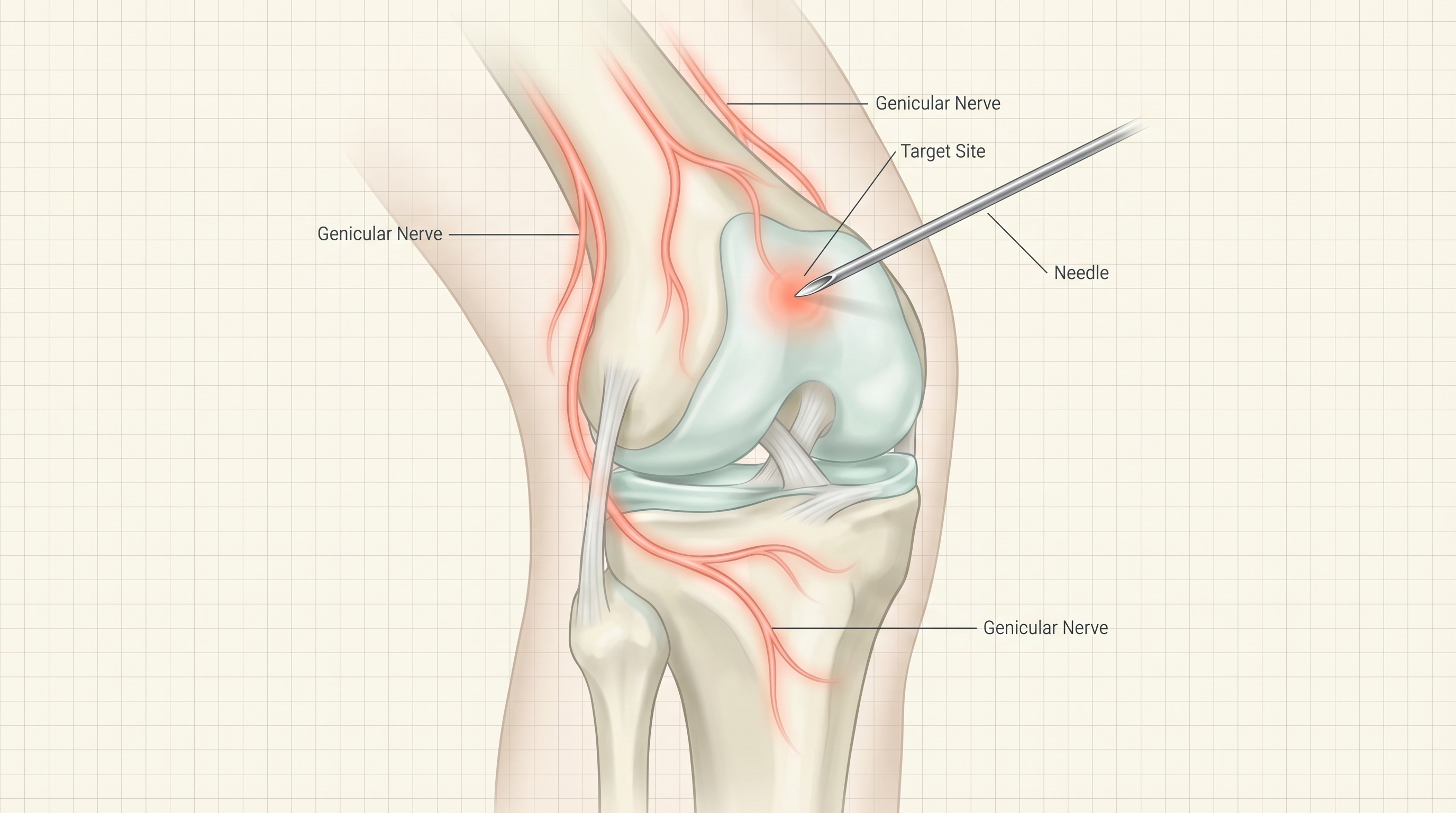
The most common nerve block for knee osteoarthritis targets the genicular nerves, which are the primary pain pathways from the knee joint:
Target nerves:
- Superior medial genicular nerve
- Superior lateral genicular nerve
- Inferior medial genicular nerve
These three nerves account for the majority of pain signals from the knee joint. By blocking all three, most knee OA pain can be significantly reduced.
Suprascapular Nerve Block (For Shoulder Pain)
The suprascapular nerve carries approximately 70% of pain signals from the shoulder joint. Blocking this single nerve can provide substantial relief for shoulder arthritis and frozen shoulder.
Hip Nerve Blocks
Hip pain can be addressed through:
- Obturator nerve block: Targets pain from the inner hip
- Femoral nerve block: Addresses anterior hip pain
- Lateral femoral cutaneous nerve block: For pain on the outer hip/thigh
The Procedure
Preparation
- You may need to stop blood thinners temporarily (discuss with your doctor)
- Eat lightly before the procedure
- Wear comfortable, loose clothing
- Bring a driver (recommended, though not always required)
During the Procedure
- Positioning. You lie on a procedure table. The area is cleaned and sterilized.
- Imaging setup. Fluoroscopy (live X-ray) or ultrasound is positioned to guide needle placement. Image guidance is critical for accuracy.
- Local anesthetic. The skin over the injection site is numbed.
- Needle advancement. Using imaging guidance, the physician advances a thin needle to the target nerve.
- Test injection. A small amount of contrast dye or anesthetic confirms the needle is correctly positioned.
- Medication delivery. The full dose of anesthetic (and steroid, if therapeutic) is injected.
- Repeat for additional nerves. For genicular nerve blocks, the process is repeated at each of the three nerve sites.
The entire procedure takes 15-30 minutes.
After the Procedure
- You may feel numbness, tingling, or warmth in the treated area immediately
- Pain relief from the anesthetic starts within minutes
- You can typically walk out of the clinic
- Mild soreness at injection sites is common for 1-2 days
- Avoid strenuous activity for 24 hours
- Resume normal activities as tolerated the next day
Pain Management Options Guide
Get our free comparison guide for nerve blocks, RFA, gel shots, and other pain management treatments.
Join 10,000+ readers. No spam.
Who Benefits Most?
Nerve blocks are most appropriate for:
Chronic joint pain patients who:
- Have not found adequate relief from oral medications and physical therapy
- Want to identify the specific source of their pain
- Are considering RFA and need a diagnostic block first
- Need short-term pain relief for rehabilitation (a therapeutic block can make physical therapy more tolerable)
- Are not candidates for surgery due to health conditions or personal preference
- Want to avoid systemic medications that affect the stomach, kidneys, or liver
Patients in the treatment decision process:
- Nerve blocks help clarify whether pain is coming from the joint or from surrounding structures (bursae, tendons, referred pain from the spine)
- This diagnostic precision helps avoid inappropriate treatments
Nerve Blocks vs. Other Treatments
vs. Cortisone Injections
| Factor | Nerve Block | Cortisone Injection |
|---|---|---|
| Target | Nerves outside the joint | Inside the joint |
| Mechanism | Blocks pain signals | Reduces inflammation |
| Best for | Chronic nerve-mediated pain | Acute joint inflammation |
| Duration | Hours (diagnostic) to weeks | 4-12 weeks |
| Repeat frequency | As needed for diagnosis | Limited to 3-4/year |
| Cartilage effect | None | Potential damage with frequent use |
vs. Gel Shots
Nerve blocks and gel injections serve different purposes:
- Gel shots restore joint lubrication and may protect cartilage
- Nerve blocks interrupt pain signals without entering the joint
- They can be used together in a comprehensive pain management plan
vs. Radiofrequency Ablation
A nerve block is often the first step toward RFA:
- The nerve block is the diagnostic test
- If the block works, RFA provides longer-lasting relief (6-12 months)
- RFA uses heat instead of medication to disable the nerve
- Learn more in our complete RFA guide
Risks and Limitations
Nerve blocks are among the safest pain management procedures, but potential risks include:
Common:
- Temporary numbness beyond the intended area
- Injection site soreness (1-2 days)
- Temporary weakness if the block affects a motor nerve (rare with proper guidance)
Uncommon:
- Infection (very low risk with sterile technique)
- Bleeding or bruising
- Allergic reaction to the anesthetic (rare)
- Temporary increase in blood sugar (if steroid is included, relevant for diabetics)
Limitations:
- Therapeutic blocks provide temporary relief (days to weeks)
- Multiple sessions may be needed to confirm a diagnosis
- Not all joint pain is nerve-mediated; some pain originates from inflammation or mechanical dysfunction within the joint itself
- Effectiveness varies between patients
What to Expect from Your Doctor Visit
When discussing nerve blocks with your pain management specialist, expect:
- Thorough evaluation of your pain pattern, location, and history
- Review of previous treatments and their effectiveness
- Discussion of goals: Are you seeking diagnosis, temporary relief, or a pathway to RFA?
- Imaging review: X-rays or MRI findings help determine if a nerve block is appropriate
- Informed consent: You should understand the procedure, expected outcomes, and risks
- Scheduling: Diagnostic blocks are often done as a first step, with follow-up based on your response
Frequently Asked Questions
How painful is a nerve block?
Most patients describe it as mild to moderate discomfort. The skin is numbed with local anesthetic before the procedure needle is advanced. You may feel pressure, a brief sting, or a tingling sensation when the needle reaches the nerve target. The actual injection takes only seconds per nerve.
How quickly will I know if the block worked?
For diagnostic blocks, you should notice pain relief within 15-30 minutes. Your doctor may ask you to perform activities that normally cause pain (walking, bending, stairs) to assess the response. Keep a pain diary for the duration of the block’s effect.
Can nerve blocks be repeated?
Yes. Diagnostic blocks may be repeated to confirm results (some insurance protocols require two positive blocks). Therapeutic blocks can be repeated as needed, though if you are getting frequent therapeutic blocks, RFA may be a more practical long-term option.
Will I lose feeling in my knee permanently?
No. Nerve blocks are temporary by design. The anesthetic wears off in hours to a day. Even RFA, which provides longer-lasting results, is not truly permanent. The nerves regenerate over months.
Do nerve blocks work for everyone?
No. If your pain comes from sources other than the targeted nerves (e.g., inflammation inside the joint, referred pain from the hip or spine, or soft tissue problems), a genicular nerve block will not help. This is why the diagnostic block is so valuable. It identifies whether nerve-targeted therapy is the right approach for you.
Is a nerve block the same as an epidural?
No. An epidural targets nerves in the spine and is used for back/leg pain or during labor. Joint nerve blocks target peripheral nerves near the specific joint. The concept is similar (blocking pain signals), but the location and application are different.
This article is for informational purposes only and does not replace professional medical advice. Consult a pain management specialist to determine if nerve blocks are appropriate for your specific condition.
Last medically reviewed: March 2026
Topics
Enjoyed this article?
Get more insights like this delivered to your inbox weekly.
Join 10,000+ readers. No spam.