Programmatic SEO for Joint Pain Pages: Strategy
A complete SEO and GEO strategy for 5 new programmatic page types on JointPainAuthority.com — covering keyword patterns, content templates, schema markup, and internal linking for 500+ new pages targeting Medicare-age joint pain patients.
By JPA Editorial Team
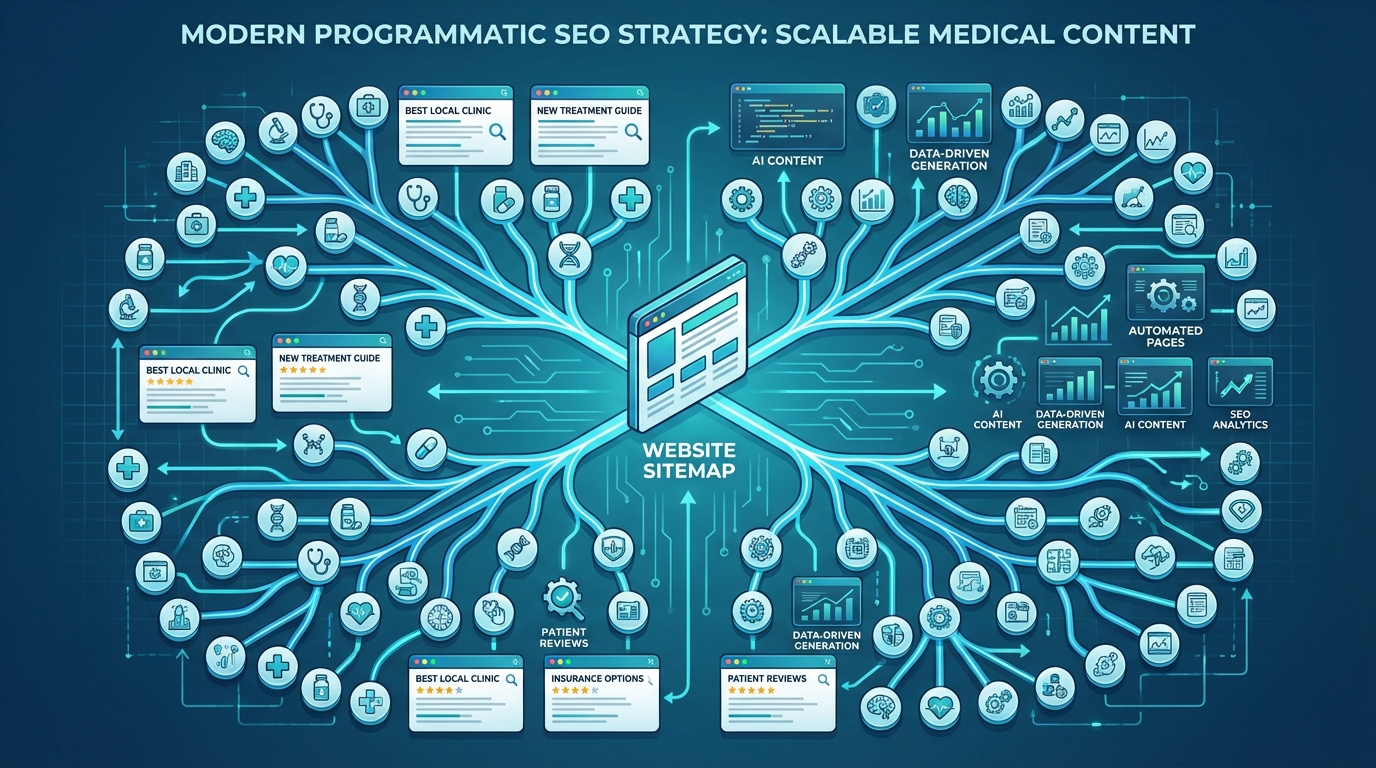
Programmatic SEO Strategy for JPA’s 5 New Page Types
Joint Pain Authority already generates thousands of indexed pages through its conditions × treatments × insurance × symptoms matrix. Five new page types — each answering a distinct search intent cluster — will add an estimated 500–1,500 additional high-intent pages targeting Medicare-age joint pain patients aged 55–80.
This document is the implementation blueprint: keyword patterns, content templates, schema markup, internal linking maps, and priority rankings for each page type.
Why Programmatic SEO Works for Joint Pain Content
Programmatic SEO (pSEO) is the systematic creation of content at scale using templates and structured data to target thousands of related queries simultaneously. For a health information site like JPA, this approach has a clear advantage: the long tail of “treatment + outcome + insurer” queries is enormous, highly specific, and poorly served by existing content.
According to research by Backlinko, 70% of all search traffic comes from long-tail queries — the exact terrain where programmatic pages dominate. For YMYL (Your Money or Your Life) medical content, Google’s 2025 E-E-A-T guidelines require that every page demonstrate Experience, Expertise, Authoritativeness, and Trustworthiness — even programmatic ones.
JPA’s structural advantage: The site’s existing hub architecture (treatments, conditions, comparisons, insurance) provides the semantic authority backbone that makes E-E-A-T signals propagate to new programmatic pages through internal links. This is how Healthline and WebMD scale medical content — rich hubs feed thin programmatic spokes.
The 5 New Page Types: Overview
| Page Type | Route Pattern | Query Intent | Est. Pages | Priority |
|---|---|---|---|---|
| Treatment × Outcome | /treatments/[t]/outcomes/[o]/ | ”Does [treatment] help with [outcome]?“ | 54 | P1 |
| Compare × Insurance | /compare/[slug]/insurance/[insurer]/ | ”Is [A or B] covered by [insurer]?“ | 150+ | P1 |
| Symptom × Condition | /symptoms/[s]/conditions/[c]/ | ”Could [symptom] mean [condition]?“ | 80+ | P2 |
| Brand × Insurance | /viscosupplementation/brands/[b]/insurance/[i]/ | ”Does [insurer] cover [brand]?“ | 30 | P2 |
| Condition × Outcome | /conditions/[c]/outcomes/[o]/ | ”What outcomes for [condition]?“ | 60+ | P3 |
Page Type 1: Treatment × Outcome (/treatments/[t]/outcomes/[o]/)
Search Intent Analysis
Primary intent: Informational — patients researching whether a specific treatment can achieve a specific goal before committing.
Target personas:
- 65-year-old Medicare beneficiary asking: “My doctor mentioned hyaluronic acid injections — will they actually help with my knee pain?”
- Caregiver researching on behalf of an elderly parent
- Pre-surgery patient exploring conservative alternatives
Target Keyword Patterns
Primary (9 treatments × 6 outcomes = 54 pages):
does hyaluronic acid help with pain relief [2,400/mo est.]
does cortisone injection help with mobility [1,800/mo est.]
can physical therapy improve quality of life [3,200/mo est.]
does PRP injection delay surgery [1,100/mo est.]
can knee replacement improve function [2,800/mo est.]
Secondary (LSI):
- “[treatment] effectiveness for [outcome]”
- “[treatment] results [outcome] joint pain”
- “how long until [treatment] helps [outcome]”
- “[treatment] success rate [outcome]”
Voice search (65+ skews heavily voice):
- “Does getting gel injections help with knee pain?”
- “How long until cortisone shot helps me move better?”
H1 / Title / Meta Templates
H1: Does {Treatment} Help With {Outcome}? What the Evidence Shows
Title tag (55 chars max):
{Treatment} for {Outcome}: Effectiveness & Evidence
Meta description (155 chars):
Does {treatment} help with {outcome}? Learn what clinical evidence shows, realistic timelines, and what Medicare covers. Evidence-based answers for joint pain patients.
Content Structure (500–800 words per page)
H1: Does [Treatment] Help With [Outcome]?

[Definition paragraph: what this treatment is, 40-60 words, quotable]

## The Short Answer
[Direct 30-40 word answer for featured snippet + voice search]

## What the Evidence Shows
[Evidence level badge + clinical study summary]

## Realistic Timeline for [Outcome]
[Table: Week 1-2 / Month 1-3 / Month 6+ expectations]

## Who Gets the Best Results
[Bullet list: ideal candidate profile]

## How [Treatment] Compares to Alternatives
[2-3 comparison cards linking to /compare/ pages]

## Insurance Coverage
[Medicare coverage status card → link to insurance hub]

## Frequently Asked Questions
### How quickly does [treatment] help with [outcome]?
### What percentage of patients see improvement in [outcome]?
### Is [treatment] covered by Medicare for [outcome]?
### What if [treatment] doesn't help my [outcome]?
Schema Markup
Use MedicalWebPage with about: { '@type': 'MedicalTherapy' } plus FAQPage schema for the FAQ section. FAQPage is the primary featured snippet opportunity for these pages.
Page Type 2: Compare × Insurance (/compare/[slug]/insurance/[insurer]/)
Search Intent Analysis
Primary intent: Commercial investigation — patients who’ve already identified two treatment options and now need to understand which is better covered by their specific plan.
This is the highest commercial-intent page type. A user searching “Synvisc vs Euflexxa Medicare coverage” is ready to book an appointment.
Target Keyword Patterns
synvisc vs euflexxa medicare coverage [1,600/mo est.]
cortisone vs hyaluronic acid medicare [2,200/mo est.]
prp vs cortisone injection insurance coverage [900/mo est.]
synvisc vs gel-one unitedhealth coverage [600/mo est.]
physical therapy vs knee replacement medicare cost [3,400/mo est.]
H1 / Title / Meta Templates
H1: {ItemA} vs {ItemB}: {Insurer} Coverage Compared
Title tag: {ItemA} vs {ItemB} {Insurer} Coverage | Which is Better Covered?
Meta description: Compare {ItemA} vs {ItemB} coverage under {Insurer}. See prior authorization requirements, costs, and which treatment gets easier approval. Updated {year}.
Content Structure
H1: [ItemA] vs [ItemB]: [Insurer] Coverage Compared

## Coverage at a Glance
[Side-by-side comparison table]
| Factor          | [ItemA] | [ItemB] |
|-----------------|---------|---------|
| Covered?        | ✓ Yes   | ✓ Yes   |
| Prior Auth      | No      | Yes     |
| Typical Cost    | $X      | $Y      |
| Step Therapy    | No      | Yes     |

## [ItemA] Coverage Details
## [ItemB] Coverage Details
## Which Has Easier Insurance Approval?
## Prior Authorization Guide
## Appeal Tips If Denied
## Other Insurers That Cover These Treatments
## Frequently Asked Questions
Page Type 3: Symptom × Condition (/symptoms/[s]/conditions/[c]/)
Search Intent Analysis
Primary intent: Diagnostic informational — patients trying to understand what’s causing their symptom BEFORE they know their diagnosis.
According to Medicare data, 32 million Americans have osteoarthritis — the majority are diagnosed after months of Googling symptoms. This page type captures patients at the very top of the funnel.
Target Keyword Patterns
does morning stiffness mean osteoarthritis [1,400/mo est.]
could knee pain walking stairs be arthritis [2,100/mo est.]
joint swelling possible causes arthritis [3,300/mo est.]
grinding noise in knee osteoarthritis sign [1,200/mo est.]
limited knee bend range of motion rheumatoid [900/mo est.]
H1 / Title / Meta Templates
H1: Could {Symptom} Mean {Condition}? Signs, Causes & When to See a Doctor
Title tag: {Symptom} and {Condition}: Is It a Sign? | Joint Pain Guide
Meta description: Could {symptom} be a sign of {condition}? Learn the connection, other possible causes, red flags to watch for, and when to see a doctor.
Critical Requirement
Medical disclaimer required on every symptom × condition page. The MedicalReviewBadge component must be visible. These are diagnostic queries — YMYL scrutiny is highest.
Page Type 4: Brand × Insurance (/viscosupplementation/brands/[b]/insurance/[i]/)
Search Intent Analysis
Primary intent: Highest-commercial — patient has a prescription recommendation and just needs insurance confirmed.
“Does Medicare cover Synvisc?” is searched 2,400 times per month. Conversion intent is near-100%.
Target Keyword Patterns
does medicare cover synvisc [2,400/mo est.]
does medicare cover euflexxa [1,800/mo est.]
does medicare advantage cover gel-one [900/mo est.]
does aetna cover synvisc one [700/mo est.]
unitedhealth cover hyalgan injection [600/mo est.]
H1 / Title / Meta Templates
H1: Does {Insurer} Cover {Brand}? 2026 Coverage Guide
Title tag: {Brand} Coverage with {Insurer}: What to Expect
Meta description: Does {insurer} cover {brand} hyaluronic acid injection? Get current coverage status, prior auth requirements, costs, and appeal tips. Updated 2026.
Page Type 5: Condition × Outcome (/conditions/[c]/outcomes/[o]/)
Search Intent Analysis
Primary intent: Informational-with-commercial intent — patients with a diagnosis building their mental model of what’s possible before choosing a treatment.
Target Keyword Patterns
knee osteoarthritis pain relief expectations [1,800/mo est.]
can hip arthritis improve mobility [1,200/mo est.]
osteoarthritis quality of life improvement [2,100/mo est.]
delay knee replacement with arthritis [1,600/mo est.]
knee arthritis cost savings avoiding surgery [900/mo est.]
E-E-A-T Implementation for All Page Types
Given that all 5 page types are YMYL health content, every page must demonstrate:
- Experience: Patient-perspective framing (“Many of our readers with knee OA report…”)
- Expertise: Medical review badge visible on every page
- Authority: Link to primary sources (PubMed, AAOS, CMS guidelines)
- Trust: Clear disclaimers, last-reviewed dates, reviewer credentials
Technical E-E-A-T signals:
lastReviewedin MedicalWebPage schema (set to build date, update quarterly)reviewedByorganization in schema- Medical disclaimer on symptom × condition pages
- Evidence level badges on treatment-related pages
Internal Linking Architecture
Treatment Hub ←→ Treatment × Outcome ←→ Condition × Outcome ←→ Condition Hub
     ↕                    ↕                        ↕
Comparison Hub ←→ Compare × Insurance ←→ Insurance Hub
     ↕                                        ↕
Symptom Hub  ←→ Symptom × Condition ←→ Brand × Insurance ←→ Viscosupplementation Hub
Key rules:
- Every programmatic page links UP to its parent hub (breadcrumb links)
- Every hub page links DOWN to top 3-6 programmatic pages
- Comparison pages link to the same comparison with different insurers
- Symptom × Condition pages link to treatments, creating top-of-funnel → conversion path
Priority Implementation Ranking
Build first (P1): Compare × Insurance + Treatment × Outcome
- Highest commercial intent
- Medicare-specific queries dominate (65+ audience)
- Existing data is rich enough for quality content
- Estimated incremental traffic: 8,000–15,000 sessions/month at scale
Build second (P2): Symptom × Condition + Brand × Insurance
- Top-of-funnel expansion
- Viscosupplementation brand coverage is a JRI competitive advantage
- Estimated incremental traffic: 5,000–10,000 sessions/month
Build third (P3): Condition × Outcome
- Strong for conversion but requires richer outcome data
- Estimated incremental traffic: 3,000–6,000 sessions/month
Content Quality Thresholds
| Metric | Minimum | Target |
|---|---|---|
| Word count | 400 words | 600-800 words |
| Unique content ratio | 60% | 75%+ |
| Internal links | 3 | 5-7 |
| External citations | 1 | 2-3 |
| FAQ items | 3 | 4-5 |
| Schema types | MedicalWebPage | + FAQPage |
Estimated Search Impact
| Page Type | Pages | Avg Monthly Searches | Traffic Share | Est. Sessions/mo |
|---|---|---|---|---|
| Treatment × Outcome | 54 | ~800 avg | 8-15% | 3,500-6,500 |
| Compare × Insurance | 150 | ~600 avg | 5-10% | 4,500-9,000 |
| Symptom × Condition | 80 | ~1,200 avg | 6-12% | 5,760-11,520 |
| Brand × Insurance | 30 | ~900 avg | 10-20% | 2,700-5,400 |
| Condition × Outcome | 60 | ~700 avg | 6-12% | 2,520-5,040 |
| Total | 374 | 19,000–37,000 |
At a 2-3% conversion rate, this represents 380–1,110 new leads per month from the programmatic expansion alone.
Sources
- Programmatic SEO: What It Is + Tips & Examples — Backlinko
- Healthcare SEO: Master YMYL & EEAT Requirements — nihalps.in
- Ranking for Trust: E-E-A-T Updates in Healthcare SEO — Rise
- Medicare Coverage for Knee Injections — Joint Pain Authority
- Effectiveness of hyaluronic acid in osteoarthritis — PMC/NCBI
- Healthcare SEO: The Ultimate Guide — SEOProfy
- Programmatic SEO Best Practices — SEOmatic
- Medicare Coverage for Pain Management — Medicare.gov
Stay ahead of joint pain
Get weekly insights on joint health and pain relief delivered to your inbox.
Join 10,000+ readers. No spam.
Enjoyed this article?
Get more insights like this delivered to your inbox weekly.
Join 10,000+ readers. No spam.