GAE vs Gel Injections: Which Is Right for You?
Compare genicular artery embolization (GAE) and gel injections (viscosupplementation) for knee osteoarthritis. Learn how each works, who they help, costs, and when to consider each option.
By Joint Pain Authority Team
Quick Answer
GAE and gel injections are both non-surgical treatments for knee osteoarthritis, but they work through completely different mechanisms. Gel injections restore joint lubrication with hyaluronic acid and are widely available, well-established, and covered by Medicare. GAE blocks abnormal blood vessels feeding knee inflammation and is a newer option showing 92% pain improvement at 12 months. Many patients may benefit from trying gel injections first, then considering GAE if they do not get adequate relief.
Two Different Approaches to the Same Problem
Both GAE and gel injections aim to reduce knee pain without surgery, but they target different parts of the osteoarthritis problem.
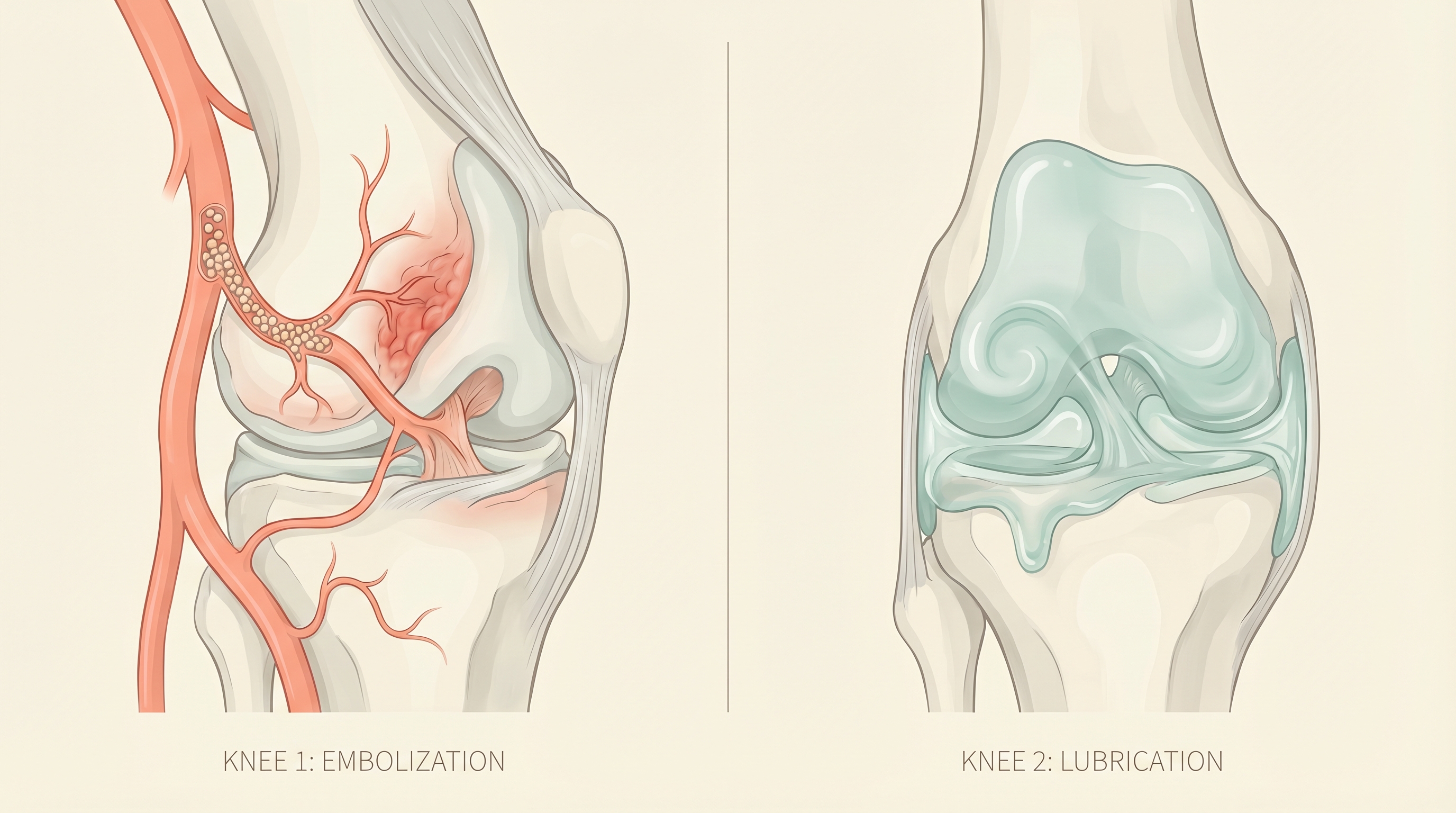
Gel injections (viscosupplementation) add hyaluronic acid directly into the knee joint. Hyaluronic acid is a natural component of healthy joint fluid that breaks down with arthritis. Replacing it restores lubrication and cushioning, reduces friction, and can provide pain relief lasting 6-12 months.
Genicular artery embolization (GAE) targets the abnormal blood vessels (neovascularity) that grow into the knee joint lining during arthritis. These new vessels carry inflammatory cells and nerve fibers that amplify pain. Blocking them with tiny microspheres reduces inflammation at the source.
Think of it this way: gel injections oil a squeaky hinge, while GAE turns off the heat that is warping the hinge in the first place.
Side-by-Side Comparison
| Factor | Gel Injections | GAE |
|---|---|---|
| How it works | Restores joint lubrication | Blocks abnormal blood vessels |
| Mechanism target | Cartilage/joint fluid | Inflammatory blood supply |
| Procedure setting | Doctor’s office | Interventional radiology suite |
| Procedure time | 5-10 minutes | ~1 hour |
| Anesthesia | None or local | Local |
| Recovery | 24-48 hours | 1-2 days |
| Pain relief onset | 2-4 weeks | Days to 3 months |
| Duration of relief | 6-12 months | 12+ months (early data) |
| Repeatable | Yes, every 6-12 months | Yes |
| FDA status | FDA-approved since 1997 | Off-label use of approved devices |
| Evidence base | 27+ years, extensive RCTs | Growing, GENESIS trial + multi-center studies |
| Medicare coverage | Yes | Some, via IR codes |
| Typical cost | $500-$1,500 per series | $5,000-$15,000 |
| Availability | Widely available | Limited to specialized centers |
Who Responds Best to Each Treatment?
Gel Injections Work Best For
GAE Works Best For
The Evidence Compared
Gel Injection Evidence (27+ Years)
- FDA-approved for knee osteoarthritis since 1997
- 51% average pain reduction in clinical studies
- 182,000-patient study showed gel injections delayed knee replacement by 370+ days
- Patients receiving 5+ courses delayed surgery by an average of 3.6 years
- Multiple FDA-approved brands (Synvisc, Supartz, Gel-One, Monovisc, and more)
- Supported by extensive real-world data from millions of treatments
GAE Evidence (Newer but Promising)
- 92% of patients met the WOMAC MCID for pain improvement at 12 months
- Only 5.2% needed knee replacement within 2 years
- GENESIS trial provides randomized controlled evidence from the U.S.
- Consistent positive results from studies in Japan, Europe, and the United States
- Longer-term data (5+ years) is still being collected
The key difference: gel injections have a mature evidence base built over decades, while GAE has highly promising but still-developing data. Both show meaningful benefits, but gel injections carry less uncertainty because the long-term picture is well understood.
Cost and Insurance Comparison
| Cost Factor | Gel Injections | GAE |
|---|---|---|
| Per treatment | $500-$1,500 | $5,000-$15,000 |
| Annual cost (if repeated) | $500-$1,500 | $5,000-$15,000 |
| Medicare Part B | Covered | Emerging coverage |
| Private insurance | Most plans cover | Inconsistent |
| Prior authorization | Usually required | Varies by insurer |
| Out-of-pocket risk | Low | Higher |
For many patients, gel injections offer a significantly lower financial barrier. A full series of gel injections typically costs less than a single GAE procedure. This makes gel injections a logical first step before considering GAE.
For detailed cost information, see our GAE cost and insurance guide and our insurance coverage guide for gel injections.
A Practical Treatment Pathway
For most patients with knee osteoarthritis, the treatments build on each other. Here is how GAE and gel injections typically fit into a comprehensive plan.
Suggested Sequence
- Physical therapy + lifestyle modifications — the foundation
- Cortisone injections — for acute flare-ups and short-term relief
- Gel injections — for longer-lasting lubrication-based relief (6-12 months)
- GAE — if gel injections and cortisone have not provided adequate relief and you want to avoid surgery
- Knee replacement — when conservative and minimally invasive options have been exhausted
This does not mean you must follow this exact order. Your doctor may recommend a different approach based on your specific condition, the nature of your pain (inflammatory vs. mechanical), and your imaging findings.
Can You Combine GAE and Gel Injections?
Yes. Because they work through different mechanisms, GAE and gel injections can potentially complement each other.
- GAE reduces the inflammatory blood supply driving pain
- Gel injections restore lubrication to the joint surfaces
A patient who has GAE to address inflammation might still benefit from gel injections to improve joint mechanics. This combination approach is an area of active interest among researchers, though formal studies on the combination are still early.
Non-Surgical Knee Pain Updates
Stay informed about the latest in non-surgical knee treatments, from gel injections to GAE to emerging therapies.
Join 10,000+ readers. No spam.
Frequently Asked Questions
Should I try gel injections before GAE?
For most patients, yes. Gel injections are widely available, covered by insurance, well-studied, and less expensive. They are a logical first step. If gel injections do not provide adequate relief, GAE offers a different approach that targets the inflammatory component of your pain.
Can GAE work if gel injections did not?
Yes. Since they address different aspects of osteoarthritis, failing to respond to gel injections does not mean GAE will also fail. In fact, many GAE candidates are specifically patients who have not gotten enough relief from injections.
Which treatment lasts longer?
Gel injections typically provide 6-12 months of relief per series. Early GAE data shows significant relief at 12+ months. However, gel injections have a well-understood repeat schedule, while long-term GAE data is still maturing.
Is one treatment safer than the other?
Both have favorable safety profiles. Gel injections have a longer safety track record (27+ years) with rare side effects like temporary joint swelling. GAE is slightly more involved as a catheter-based procedure, with risks including minor bruising, temporary skin discoloration, and rare non-target embolization. Serious complications are uncommon with either treatment.
My doctor has not mentioned GAE. Should I bring it up?
Yes. GAE is newer and not all orthopedists are familiar with it. If you have moderate arthritis with an inflammatory component and have not had success with injections, asking about GAE is reasonable. You may need a referral to an interventional radiologist who performs the procedure.
Are there situations where gel injections are better than GAE?
Absolutely. If your primary issue is joint stiffness and mechanical pain rather than inflammatory warmth and swelling, gel injections may address your problem more directly. They are also a better fit if cost or insurance coverage is a concern, or if you prefer a treatment with decades of outcome data.
This article is for informational purposes only and does not replace medical advice. Discuss your treatment options with your healthcare provider.
Last reviewed: April 2026
Related Resources
Enjoyed this article?
Get more insights like this delivered to your inbox weekly.
Join 10,000+ readers. No spam.