How Long Do Knee Injections Take to Work? Timeline by Injection Type
How long does a knee injection take to work? Cortisone works in 3-5 days, gel injections in 2-5 weeks, and PRP in 4-6 weeks. Evidence-based timelines for each injection type with week-by-week expectations.
By Joint Pain Authority Team
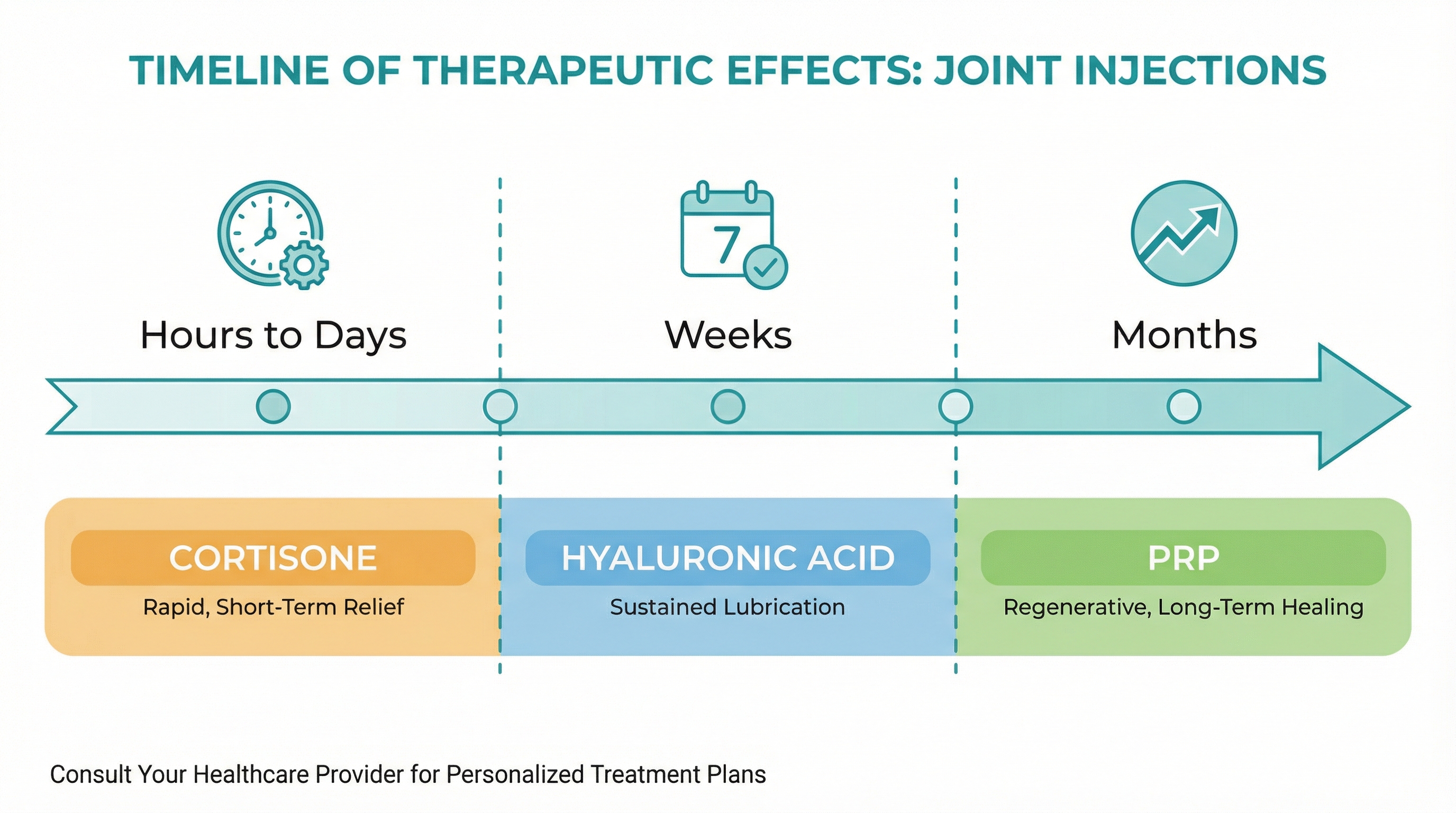
You just had a knee injection, or you are about to schedule one, and the same question keeps circling: when will I actually feel better? The answer depends entirely on which type of injection you receive. Cortisone, hyaluronic acid (gel), and PRP injections each work through different mechanisms, and their timelines differ significantly.
Here is what clinical research shows about when each injection starts working, when it peaks, and how long relief typically lasts.
Key Takeaways
Quick Answer: Knee Injection Timeline Comparison
| Cortisone | Gel (Hyaluronic Acid) | PRP | |
|---|---|---|---|
| First relief | 3-5 days | 2-5 weeks | 4-6 weeks |
| Peak benefit | ~2 weeks | 5-13 weeks | 3-6 months |
| Duration | 4-12 weeks | 6-12 months | 6-12+ months |
| Mechanism | Anti-inflammatory | Restores joint lubrication | Biological tissue repair |
| Speed advantage | Fastest acting | Moderate onset | Slowest onset |
| Duration advantage | Shortest lasting | Long lasting | Longest potential |
Now let’s break down each injection type in detail so you know exactly what to expect week by week.
Cortisone Injection Timeline: Week by Week
Cortisone (corticosteroid) injections work by suppressing inflammation inside the knee joint. They are the fastest-acting option, but their benefits are also the most temporary.
What Happens After a Cortisone Shot
Hours 1-24: Local anesthetic effect. Most cortisone injections include a numbing agent (like lidocaine). You may feel immediate relief, but this wears off within hours. Some patients experience a temporary pain flare during this window. About 10-20% of patients have a post-injection flare that lasts 1-3 days.
Days 3-5: Cortisone kicks in. The steroid begins suppressing inflammatory mediators in the joint. Research shows that over 50% of patients report improvement by day 3, and more than 95% experience relief by day 8.
Weeks 1-2: Peak benefit. Clinical studies show peak pain reduction around 10-14 days post-injection. A meta-analysis in the BMJ found that two-thirds of patients achieve clinically meaningful symptom improvement within two weeks.
Weeks 3-6: Sustained relief. Pain reduction of approximately 24-27% from baseline is typical through this period. Physical function and stiffness also improve.
Months 2-3: Gradual decline. Benefit begins fading. Studies show pain reduction drops to about 21% at three months and 17% at six months.
Months 4-6: Return toward baseline. Research indicates that 73% of patients show positive response at two weeks, but only 29% maintain that improvement at six months.
About post-injection flares: If your knee feels worse for 1-3 days after a cortisone shot, that is normal. Pain flares occur in roughly 10-20% of patients and are more common in younger individuals. Apply ice and take over-the-counter pain relievers as needed. The flare typically resolves within 3-5 days, and it does not mean the injection failed.
Cortisone Dose Matters
Research reveals an important detail: higher doses last longer. Standard doses (about 20 mg triamcinolone) provide reliable relief for 2-4 weeks. Higher doses (equivalent to 50 mg prednisone) may extend meaningful benefit to 16-24 weeks. Ask your doctor about the appropriate dose for your situation.
Gel (Hyaluronic Acid) Injection Timeline: Week by Week
Hyaluronic acid injections (also called gel injections or viscosupplementation) work differently from cortisone. Instead of fighting inflammation, they restore the natural lubrication and cushioning in your knee joint. This different mechanism explains the slower onset but substantially longer duration.
For a more detailed breakdown of the gel injection experience, see our complete guide on what to expect from HA knee injections.
Series vs. Single Injection: Different Timelines
Gel injections come in two formats: a series of 3-5 weekly injections or a single injection of a higher-molecular-weight product. The timeline differs for each.
| Phase | 3-Injection Series | Single Injection |
|---|---|---|
| Onset | 2-4 weeks after last injection | 3-5 weeks |
| Peak | 5-13 weeks | 6-8 weeks |
| Duration | 6-12 months | 6 months |
| Best evidence | Strongest clinical support | Good for patients who cannot attend multiple visits |
Research from a meta-analysis in PubMed Central found that the 2-4 injection regimen proved most effective, providing significant pain relief at both 3 and 6 months. Single injections showed non-significant benefit at 3 months, with emerging benefit at 6 months.
Week-by-Week Gel Injection Timeline
Week 1 (after final injection in series): Mild soreness is common for 24-48 hours. Some patients feel temporary fullness in the knee from the added fluid. Do not expect pain relief yet.
Weeks 2-4: Early response. You may begin noticing subtle improvements. Pain during daily activities starts to ease. The Cochrane Review of 76 trials found beneficial effects on pain, function, and patient assessment starting in this window.
Weeks 5-8: Building relief. This is when most patients notice meaningful change. Walking becomes easier. Morning stiffness improves. Research shows the effect peaks at around 6-8 weeks following administration.
Weeks 9-13: Peak benefit. The Cochrane Review identified weeks 5-13 as the strongest benefit window, with 28-54% improvement in pain and 9-32% improvement in function from baseline.
Months 3-6: Sustained plateau. Pain relief remains near its peak. A large clinical study found that 83% of patients achieved at least 20% pain reduction, and 80% achieved clinically significant functional improvement during this period.
Months 6-12: Gradual return. Benefit slowly decreases but may persist well beyond 6 months for many patients. Medicare allows repeat treatment every 6 months if the first course was effective.
Cumulative benefit with repeat treatments: The AMELIA randomized controlled study found that patients receiving repeated courses of HA injections showed increasing responsiveness over time. Benefits persisted for at least one year after the final injection, suggesting cumulative biological effects with continued treatment.
Does Molecular Weight Affect How Fast Gel Injections Work?
Yes. High-molecular-weight HA products show superior pain improvement compared with low or medium-molecular-weight formulations, particularly at the 6-month mark. However, the onset timeline remains similar across formulations. The main difference is in magnitude and duration of relief, not speed of onset.
For a detailed comparison of available brands, see our HA vs. cortisone comparison.
PRP Injection Timeline: Week by Week
PRP (platelet-rich plasma) injections use concentrated platelets from your own blood to promote healing. Because PRP works through biological tissue repair rather than suppressing symptoms, the timeline is the slowest but potentially the most durable.
What to Expect After PRP
Week 1: Inflammation phase. Expect increased soreness and swelling. This is actually part of the healing process. PRP triggers a controlled inflammatory response that initiates tissue repair. Rest and ice are recommended.
Weeks 2-4: Early healing. Inflammation subsides. You may feel similar to or slightly worse than before the injection. This is the most frustrating period because you are healing internally without yet feeling the benefit.
Weeks 4-6: First noticeable improvement. A clinical trial of 113 patients found notable improvements in WOMAC and VAS pain scores beginning at 6 weeks post-injection. This is when most patients start feeling that the injection is “working.”
Weeks 6-12: Progressive improvement. Pain and function continue improving. A meta-analysis found clinically relevant improvements at 1-month (2.29 WOMAC points), 3-month (4.00 points), and 6-month (3.97 points) follow-up.
Months 3-6: Peak benefit. The most substantial improvement in clinical trials occurred at 24 weeks (6 months). Unlike cortisone, which peaks and then declines, PRP shows a pattern of continuous improvement through this period.
Months 6-12+: Sustained relief. Benefits persist through 12 months in most studies. A large multicenter trial over 60 months found consistently greater improvements in the PRP group compared with placebo, along with slower decline in cartilage volume.
For a detailed comparison of PRP and gel injections, see our PRP vs. HA comparison.
Visual Timeline Comparison
This table shows a side-by-side view of what you can expect at each time point.
| Time After Injection | Cortisone | Gel (HA) | PRP |
|---|---|---|---|
| Day 1-3 | Numbing wears off; possible flare | Mild soreness | Soreness and swelling |
| Day 3-7 | Pain relief begins (50%+ of patients) | No change yet | Inflammation phase |
| Week 2 | Peak benefit reached | Subtle early signs | Still healing |
| Week 4 | Good relief maintained | Noticeable improvement begins | Early improvement possible |
| Week 6 | Still effective but fading | Relief building | First clear improvement |
| Week 8 | Declining benefit | Approaching peak | Steady improvement |
| Week 13 | Minimal remaining benefit | Peak benefit window | Continuing to improve |
| Month 6 | Returned to baseline | Sustained relief | Peak benefit |
| Month 12 | Long past effectiveness | May still have partial benefit | Sustained relief |
Factors That Affect How Quickly Injections Work
Not everyone responds on the same timeline. Research has identified several factors that influence how fast and how well knee injections work.
1. Injection Accuracy
This may be the single most important factor. A systematic review found that ultrasound-guided injections achieve 96.7% accuracy compared with 81% for landmark-guided (blind) injections. Clinical improvement occurred in 52% of patients with correctly placed injections but only 23% with misplaced ones. Ask your provider whether they use ultrasound guidance.
2. Disease Severity (Kellgren-Lawrence Grade)
Patients with mild to moderate osteoarthritis (KL grade 1-2) respond faster and better than those with severe disease (KL grade 3-4). This applies to all three injection types. Earlier treatment generally produces better results.
3. Body Weight
Obesity significantly decreases the effectiveness of cortisone injections. One study found that obese patients (BMI 30+) had worse outcomes at baseline, 6 weeks, and 3 months compared with non-obese patients. Maintaining a healthy weight improves injection outcomes across all types.
4. Baseline Pain Severity
Patients with moderate-to-severe pain (WOMAC pain score of 5 or higher) actually show greater likelihood of meaningful response to cortisone than those with mild pain. If your pain is more significant, you have more room for improvement.
5. Age
Younger patients tend to respond better to PRP, likely because of greater biological regenerative capacity. For cortisone, younger patients are more likely to experience a post-injection pain flare (which delays onset by about 1.5 days) but ultimately achieve similar benefit.
6. Pain Reduction vs. Functional Improvement
An important but often overlooked distinction: pain relief typically happens before functional improvement. You may notice less pain at rest before you see improvement in walking distance or stair climbing. A study examining extended-release triamcinolone found significant improvements in chair-stand performance at 6 and 12 weeks but no improvement in fast-paced walking time. Give function extra time to catch up with pain relief.
What If Your Injection Is Not Working?
When to Contact Your Doctor
Research shows that only 9% of injection patients actually needed a follow-up within the standard 6-8 week window. Studies using pain diaries found that 43% of patients required no follow-up at all.
If Your Injection Did Not Work
A poor response does not necessarily mean surgery is the next step. Your provider may consider:
- A different injection type. If cortisone did not last, gel injections provide longer relief through a different mechanism. If gel injections did not help, PRP may work through biological repair.
- Ultrasound-guided re-injection. If your first injection was done without imaging guidance, the medication may not have reached the joint space.
- Combination therapy. A meta-analysis of 8 RCTs found that cortisone combined with hyaluronic acid provided both faster short-term and better long-term relief compared with HA alone.
- Addressing contributing factors. Weight loss, physical therapy, and bracing can all improve injection outcomes.
For a complete comparison of your injection options, see our guide to the 3 main injections for knee pain.
Stay ahead of joint pain
Get weekly insights on joint health and pain relief delivered to your inbox.
Join 10,000+ readers. No spam.
Frequently Asked Questions
How long does a cortisone injection take to work in the knee?
Most patients feel pain relief from cortisone within 3-5 days, with peak benefit around 2 weeks. The local anesthetic mixed with cortisone may provide temporary relief within hours, but this wears off before the steroid takes effect. Over 95% of patients who will respond have noticed improvement by day 8.
How long do gel injections take to start working?
Gel (hyaluronic acid) injections typically take 2-5 weeks to produce noticeable relief, with peak benefit between weeks 5-13. If you receive a series of 3 weekly injections, the timeline starts after your final injection. Single-injection formulations may take slightly longer, with benefit emerging more gradually over 3-6 weeks.
Why does PRP take so long to work?
PRP works through biological tissue repair, not symptom suppression. After injection, your platelets release growth factors that trigger a healing cascade involving inflammation, cell proliferation, and tissue remodeling. This biological process takes 4-6 weeks to produce noticeable improvement and continues for months, which is why PRP has the slowest onset but potentially the longest-lasting benefit.
Can I speed up how fast my knee injection works?
While you cannot change the biological timeline, you can optimize your response. Follow your doctor’s activity restrictions in the first 24-48 hours, use ice for any initial soreness, maintain a healthy weight, attend recommended physical therapy sessions, and choose a provider who uses ultrasound guidance for injection accuracy. Ultrasound-guided injections are 96.7% accurate vs. 81% for blind injections.
Which knee injection works fastest?
Cortisone works fastest, with relief typically beginning within 3-5 days. However, “fastest” does not necessarily mean “best.” Cortisone provides weeks of relief, while gel injections provide months and PRP may provide a year or more. Your doctor can help you decide which timeline and duration best fits your situation.
Is it normal to feel worse before feeling better after a knee injection?
Yes, particularly with cortisone and PRP. About 10-20% of cortisone patients experience a post-injection flare lasting 1-3 days. PRP intentionally triggers a healing inflammatory response that can increase soreness for 1-2 weeks. Gel injections are least likely to cause temporary worsening, though mild soreness for 24-48 hours is common. If pain is severe or accompanied by fever, contact your doctor promptly.
How do I know if my knee injection is working?
Track your pain levels, walking distance, and ability to perform daily activities like climbing stairs or getting out of a chair. Research shows that pain reduction often happens before functional improvement. A 20% or greater reduction in pain is considered clinically meaningful. Many patients find that keeping a brief daily pain diary helps them recognize gradual improvement they might otherwise miss.
Related Resources
- The 3 Main Injections for Knee Pain: Cortisone, Gel, and PRP Compared
- HA Knee Injections: What to Expect (Timeline)
- Cortisone vs. Gel Injections: Side-by-Side Comparison
- PRP vs. Hyaluronic Acid Injections
- Cortisone Injection Risks: What Repeated Shots Do to Your Cartilage
- How Long Do Gel Injections Last? Real Duration Data
References
-
Arroll B, Goodyear-Smith F. Corticosteroid injections for osteoarthritis of the knee: meta-analysis. BMJ. 2004;328(7444):869. PMC387479
-
Bellamy N, et al. Viscosupplementation for the treatment of osteoarthritis of the knee. Cochrane Database of Systematic Reviews. 2006. Cochrane
-
Clinical and Functional Outcomes Following Intra-articular Platelet-Rich Plasma Injections in Knee Osteoarthritis. PubMed Central. PMC12640551
-
Hameed F, et al. Clinical utility of ultrasound guidance for intra-articular knee injections: a review. Clinical Interventions in Aging. 2012. PMC3324992
-
Arthroscopy Association of Canada. Intra-articular Injections for Knee OA Clinical Practice Guidelines. Updated August 2020. COA-ACO
-
Petrella RJ, et al. The efficacy of multiple versus single hyaluronic acid injections: a systematic review and meta-analysis. BMC Musculoskeletal Disorders. 2017. PMC5740709
-
PRP Injections for the Treatment of Knee Osteoarthritis: Systematic Review and Meta-analysis. American Journal of Sports Medicine. 2024. SAGE
-
Efficacy and Treatment Response of Intra-articular Corticosteroid Injection in Patients with Symptomatic Knee Osteoarthritis. Sports Medicine Boston. PDF
-
Baseline Knee Pain Predicts Long-Term Response of Intra-Articular Corticosteroid Injection. PubMed Central. 2023. PMC10416197
-
Molecular Weight of Hyaluronic Acid Has Major Influence on Its Efficacy and Safety for Viscosupplementation in Hip Osteoarthritis. PubMed Central. 2022. PMC8808882
-
Navarro-Sarabia F, et al. A 40-month multicentre, randomised placebo-controlled study to assess the efficacy and carry-over effect of repeated intra-articular injections of hyaluronic acid in knee osteoarthritis: the AMELIA project. Annals of the Rheumatic Diseases. 2011.
-
Advances in hyaluronic acid therapy for knee osteoarthritis: monotherapy and combination strategies. Orthopedic Reviews. 2024. OMR
Topics
Enjoyed this article?
Get more insights like this delivered to your inbox weekly.
Join 10,000+ readers. No spam.