Exercises to Avoid with Hip Arthritis (and What to Do Instead)
Exercises that worsen hip arthritis and safer alternatives for each. Avoid deep squats, lunges, high-impact running, and heavy leg press to protect your hip joint.
By Joint Pain Authority Team
Quick Answer
Not all exercise is good for hip arthritis. High-impact activities (running on pavement, jumping), deep range-of-motion movements (deep squats, lunges), and heavy loaded exercises (leg press, heavy deadlifts) can accelerate cartilage damage and worsen pain. For every exercise to avoid, there is a safer alternative that provides similar benefits without the joint stress.
Why Some Exercises Make Hip Arthritis Worse
Exercise is one of the best treatments for hip arthritis — but the wrong exercises can do more harm than good. A study in Osteoarthritis and Cartilage (2022) tracked 2,400 adults with hip OA over 4 years and found that patients who regularly performed high-impact activities had 38% greater cartilage loss compared to those who did low-impact exercise.
The arthritic hip is vulnerable because:
- Damaged cartilage cannot absorb shock — When cartilage thins, impact forces transfer directly to bone
- Inflamed joint linings are irritable — Repetitive stress triggers more inflammation and pain
- Range of motion is reduced — Forcing a stiff hip into extreme positions creates impingement and damage
- Surrounding muscles may be weak — Weak muscles increase the forces the joint itself must bear
Understanding which movements to avoid — and what to do instead — lets you stay active while protecting your hip.
The 8 Exercises to Avoid
1. Deep Squats (Below 90 Degrees)
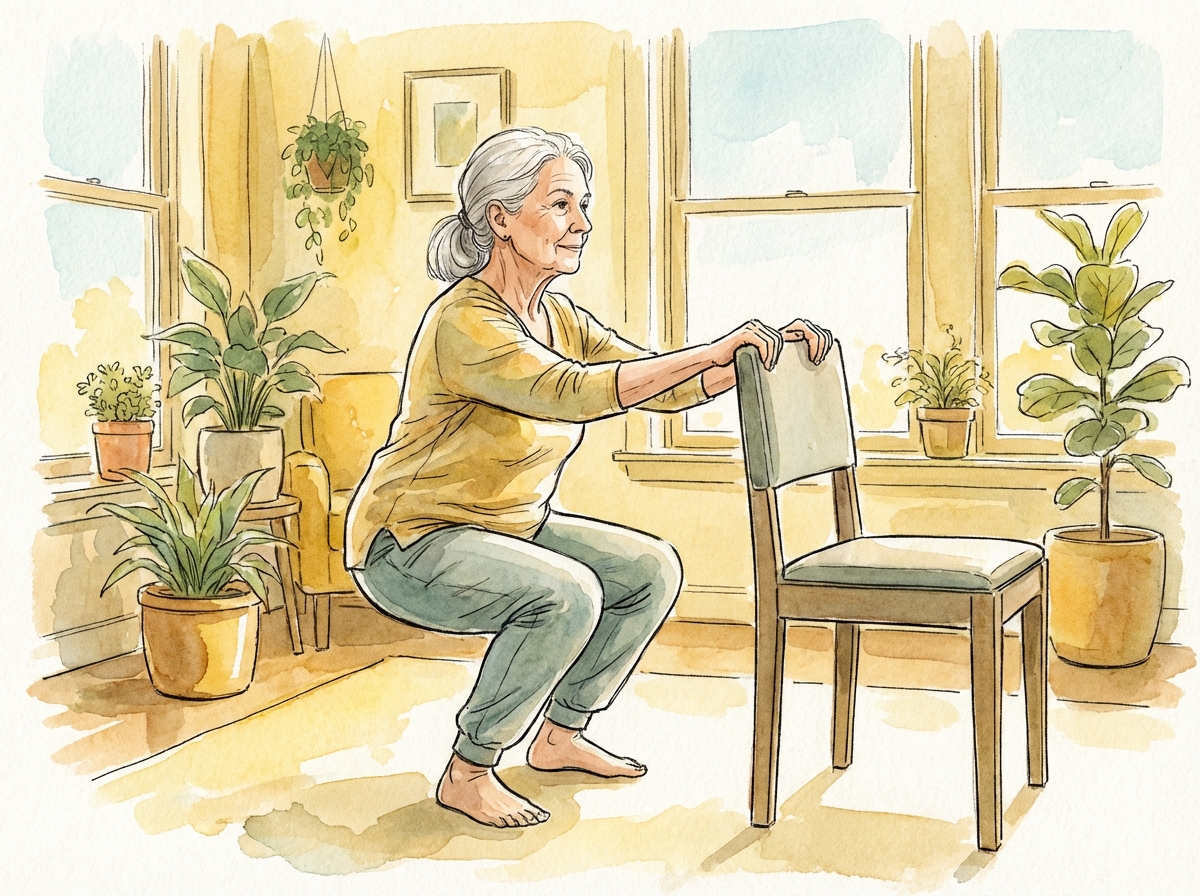
Why it is harmful: Deep squats compress the hip joint beyond its comfortable range in arthritis. At full depth, the hip experiences forces of 4-5 times body weight, and the femoral head can impinge against the acetabular rim. A biomechanical analysis in the Journal of Orthopaedic Research measured peak hip joint forces of 8.4 times body weight during deep barbell squats.
Signs you are going too deep: Pain in the groin or front of the hip at the bottom of the squat, a “catching” or “pinching” sensation, or inability to maintain a neutral spine.
Safer alternative: Partial Wall Squats or Water Squats
- Stand with your back against a wall, feet 12 inches forward
- Slide down until your knees are bent to about 45-60 degrees (quarter to half squat)
- Hold 5 seconds, slide back up
- Or perform squats in chest-deep water where buoyancy supports your weight
- 10-12 reps, 2-3 sets
2. Lunges (Forward and Walking)
Why they are harmful: Lunges place the hip in a combination of deep flexion, adduction, and rotation — the exact position that causes impingement in arthritic hips. The lead leg bears 3-4 times body weight, and the trailing leg’s hip is forced into extension that many arthritic hips cannot comfortably achieve. A study in Gait & Posture found that lunges produced 35% more hip joint force than walking.
Safer alternative: Step-Ups on a Low Step
- Use a step 4-6 inches high (a sturdy platform or the bottom stair)
- Step up with one foot, bring the other foot up to meet it
- Step back down
- This strengthens the same muscles (quads, glutes) without the extreme hip angles
- 10-12 reps per leg, 2 sets
3. Running on Hard Surfaces
Why it is harmful: Each running stride generates impact forces of 2.5-3 times body weight on the hip. On hard surfaces like concrete or asphalt, the impact is even greater because the surface does not absorb any shock. A 2023 longitudinal study in Arthritis & Rheumatology found that people with hip OA who continued running on hard surfaces had 2.1 times greater cartilage loss over 3 years compared to those who switched to low-impact activities.
Safer alternatives:
- Walking — Impact forces are only 1-1.5 times body weight. See our walking for hip arthritis guide
- Pool walking or running — Buoyancy eliminates nearly all impact. See our aquatic exercises guide
- Cycling — Zero impact; the seat supports your weight. See our cycling for hip arthritis guide
- Elliptical machine — Low impact with a running-like motion
4. Heavy Leg Press
Why it is harmful: The leg press machine forces the hip into deep flexion under heavy load. At the bottom of the movement, the hip angle can exceed 90-100 degrees while bearing hundreds of pounds. This combination compresses the arthritic joint surface and can cause cartilage damage, labral tears, and increased inflammation. A biomechanical study found peak hip forces of 6 times body weight during heavy leg press.
Safer alternative: Bodyweight Bridges or Resistance Band Exercises
- Bridges: Lie on your back, knees bent, feet flat. Lift hips to form a straight line from shoulders to knees. Hold 5 seconds. 10-15 reps, 2-3 sets.
- Standing hip abduction with resistance band: Band around ankles, lift leg sideways against resistance. 12-15 reps per side.
- Seated knee extension: Sit in a chair, straighten one leg. 10-12 reps per side.
- Read our resistance bands for hip arthritis guide for a complete routine.
5. High-Impact Aerobics and Jump Training
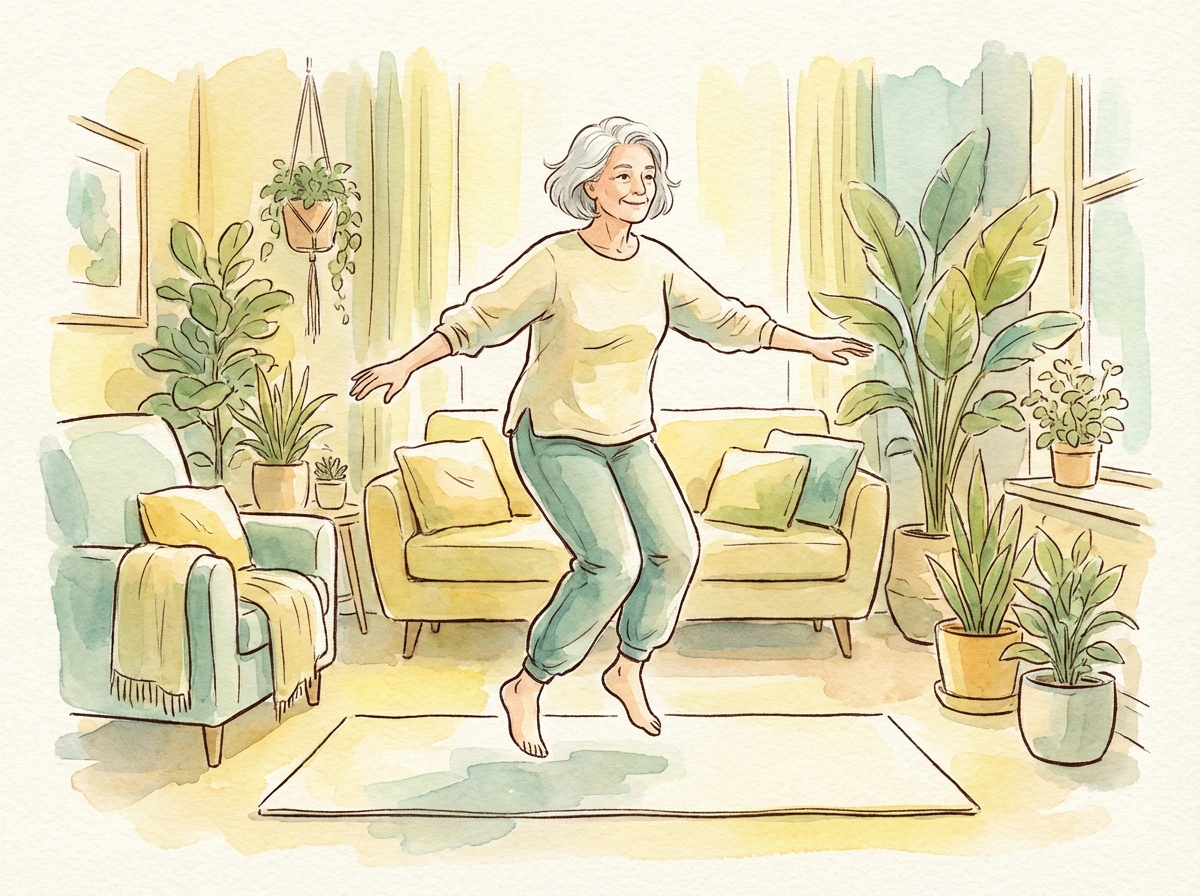
Why they are harmful: Jumping activities generate impact forces of 5-8 times body weight on landing. For an arthritic hip with compromised cartilage, this is destructive. Even “low-impact” aerobics classes sometimes include jumping jacks, burpees, or box jumps that are inappropriate for hip OA.
Safer alternatives:
- Aquatic exercise classes — The strongest evidence for hip arthritis (d=1.12 effect size)
- Tai chi — Gentle, flowing movements with excellent evidence for balance and pain. See our tai chi for hip arthritis guide
- Chair exercises — Zero impact, effective strengthening. See our chair exercises guide
6. Full Sit-Ups and Leg Raises
Why they are harmful: Full sit-ups and straight-leg raises powerfully engage the hip flexors (psoas and rectus femoris), which are often already tight and overactive in hip arthritis. This can increase anterior hip pain, worsen hip flexor contractures, and compress the joint. The psoas crosses directly over the hip joint, and its contraction during sit-ups creates a compressive force.
Safer alternative: Modified Core Exercises
- Partial curl-ups: Lie on your back, knees bent. Lift only your head and shoulders off the floor (not a full sit-up). 10-15 reps.
- Dead bugs: Lie on your back, arms up, knees bent 90 degrees. Slowly lower opposite arm and leg toward the floor. 8-10 reps per side.
- Seated core rotation: Sit in a chair, cross arms on chest, slowly rotate your trunk left and right. 10 reps each direction.
7. Stair Climbing Machines (StairMaster)
Why it is harmful: Continuous stair climbing forces the hip into repeated deep flexion under body weight. A study in the Journal of Biomechanics measured hip joint forces of 3.5-4 times body weight during stair climbing — comparable to running. While occasionally climbing stairs is part of daily life, using a stair machine for 20-30 minutes of sustained exercise is excessive for arthritic hips.
Safer alternative: Recumbent Bike or Elliptical
- The recumbent bike provides cardiovascular exercise with the hip in a comfortable, supported position
- The elliptical provides a stepping motion without the impact of actual stair climbing
- Both are well-tolerated by most hip arthritis patients
8. Aggressive Hip Stretching (Forcing Range of Motion)
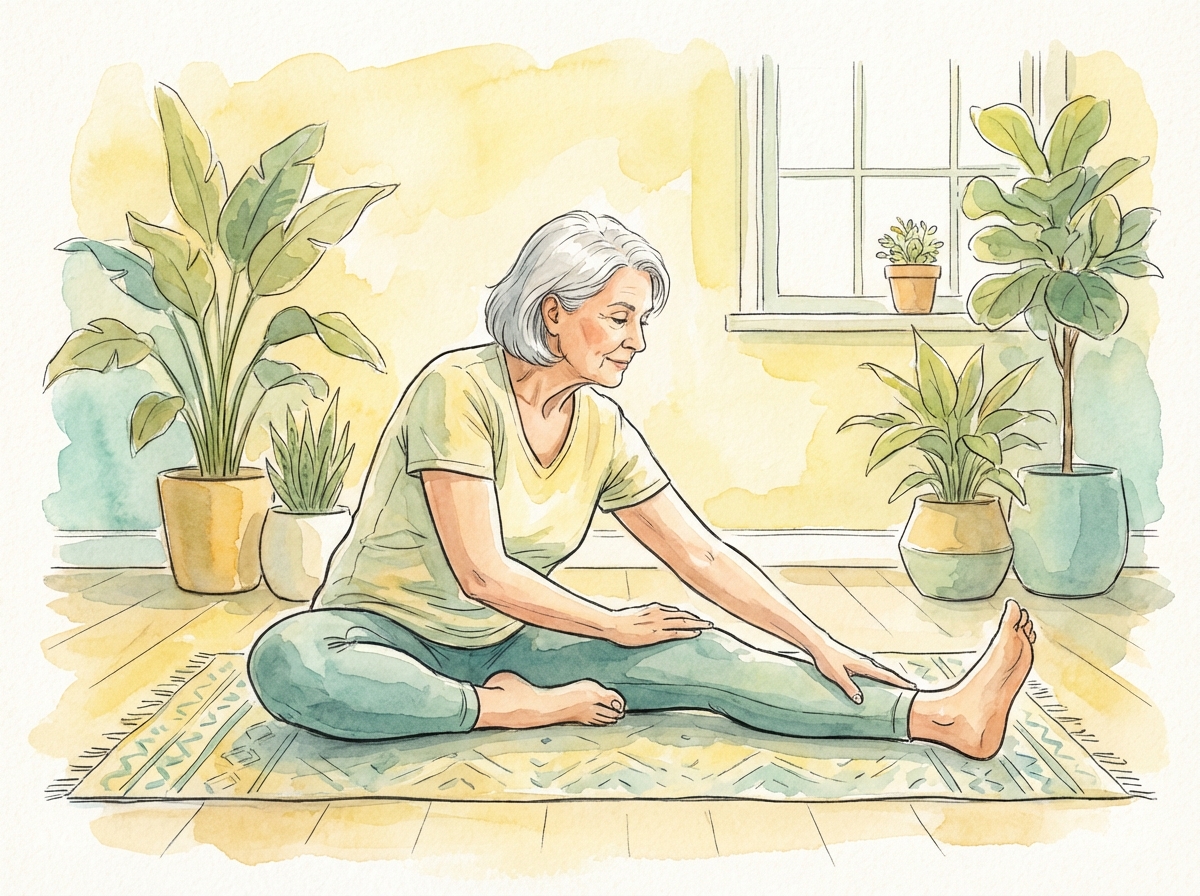
Why it is harmful: When hip arthritis reduces your range of motion, the instinct may be to stretch harder to “get it back.” But aggressively stretching a stiff, arthritic hip can damage the joint capsule, inflame the synovium, and cause painful muscle spasms. The lost range in hip OA is often caused by bone spurs and cartilage changes — structures that stretching cannot change.
Safer alternative: Gentle, Pain-Free Stretching
- Stretch only to the point of mild tension — never pain
- Hold for 20-30 seconds (no bouncing)
- Warm up first with walking or a warm shower
- Focus on the muscles around the hip (hip flexors, hamstrings, piriformis) rather than forcing the joint itself
- Read our stretching for hip arthritis guide for safe routines
Get your safe exercise plan for hip arthritis
Evidence-based exercise guides that protect your hip while building strength and reducing pain.
Join 10,000+ readers. No spam.
Quick Reference: Exercises to Avoid vs. Safer Alternatives
| Avoid | Why | Do Instead |
|---|---|---|
| Deep squats | 8.4x body weight on hip | Wall squats to 45 degrees |
| Lunges | Impingement + 3-4x body weight | Low step-ups (4-6 inch) |
| Running (hard surfaces) | 2.5-3x body weight impact | Walking, pool exercise, cycling |
| Heavy leg press | 6x body weight in deep flexion | Bridges, resistance bands |
| High-impact aerobics | 5-8x body weight on landing | Aquatic exercise, tai chi |
| Full sit-ups | Compressive hip flexor force | Partial curl-ups, dead bugs |
| Stair machine | 3.5-4x body weight sustained | Recumbent bike, elliptical |
| Aggressive stretching | Joint capsule damage | Gentle stretching to mild tension |
How to Tell if an Exercise Is Hurting Your Hip
Use the “2-hour rule” recommended by the Arthritis Foundation:
- During exercise: Mild discomfort (2-3/10 pain) is acceptable. Pain above 4/10 means stop.
- Within 2 hours after exercise: If pain returns to your pre-exercise baseline, the exercise was appropriate.
- The next morning: If you wake up with more pain than usual, the exercise was too intense. Reduce the intensity, range of motion, or number of reps.
When to Get Professional Guidance
Consider working with a physical therapist if:
- You are unsure which exercises are safe for your specific level of hip arthritis
- You have been exercising but your pain is not improving after 6-8 weeks
- You want to continue sports or activities that involve some of the movements listed above — a PT can help modify them to reduce risk
- You have other joint conditions (knee OA, back pain) that complicate your exercise choices
For a comprehensive overview of all exercise options ranked by evidence, see our hub guide on the best exercises for hip arthritis.
Frequently Asked Questions
Can I still play golf with hip arthritis?
Golf involves hip rotation under load, which can stress an arthritic hip. However, modifications can make it tolerable for many people: use a cart instead of walking, shorten your backswing, warm up thoroughly before playing, and consider a wider stance to reduce rotational stress. If golf causes persistent pain, discuss it with your doctor or PT.
Is yoga safe for hip arthritis?
Many yoga poses are excellent for hip arthritis (gentle stretches, balance poses). However, deep hip openers like Pigeon Pose, Lotus, and deep Warrior poses can cause impingement. Choose gentle or “chair yoga” classes, tell the instructor about your hip condition, and skip any pose that causes groin or hip pain. See our yoga for hip arthritis guide for safe modifications.
Are resistance machines at the gym safe?
Some are, some are not. The leg press and hip adductor/abductor machines at high weights are problematic. The seated leg curl, seated knee extension (at moderate weight), and cable hip exercises at low to moderate resistance are generally safe. A physical therapist can guide your gym program.
Can walking too much hurt my arthritic hip?
Yes, if you overdo it. Walking is beneficial, but excessive distances — especially on hard surfaces — can increase inflammation. The key is finding your “sweet spot.” Start with 10-15 minutes and add 2-3 minutes per week. If you are sore the next morning, you walked too far. Alternate walking days with rest or pool exercise days.
I used to be a runner. Will I ever run again?
Running with moderate to severe hip OA significantly accelerates cartilage loss. Switching to pool running (with a flotation belt in deep water) provides the same cardiovascular and muscular benefits without impact. Many former runners find pool running satisfying once they adjust. Read our swimming and pool exercise guide for more options.
Do high-impact exercises cause hip arthritis, or just make it worse?
Both. Research suggests that elite athletes in high-impact sports (soccer, distance running, football) have 2-3 times higher rates of hip OA compared to the general population. For people who already have hip OA, continuing high-impact activities accelerates the damage. Low-impact exercise does not carry this risk.
The information in this article is for educational purposes only and is not intended as medical advice. Always consult with your healthcare provider or physical therapist before modifying your exercise program, especially if you have moderate to severe hip arthritis.
Last medically reviewed: April 2026
Enjoyed this article?
Get more insights like this delivered to your inbox weekly.
Join 10,000+ readers. No spam.